
The current state of HALAL certification in Japan
As mentioned above, certification guidelines differ depending on the certification organization considered. Some bodies have strict rules on HALAL regulations. Some bodies pursue a Muslim-friendly policy. Equally important is whether the body has mutual recognition with Malaysia's JAKIM. All stakeholders of HALAL food (suppliers, producers, retailers, etc.) must choose a certification body according to their own management strategy.
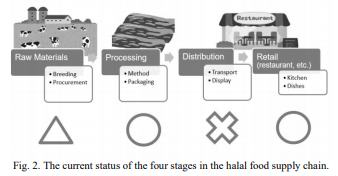
1. Japan's HALAL food supply chain
1. HALAL expert interviews
We interviewed HALAL experts who promote HALAL food and engage in inbound business under Japan's current circumstances. As shown in Figure 2, we identified a key problem in the distribution segment of the HALAL food supply chain. In the logistics from manufacturers to retailers or restaurants, it is difficult to ensure the safety of HALAL food, because almost all products are shipped together with non-HALAL products. A few distributors take action to ensure the correct delivery of HALAL food, but most do not add extra costs to meet HALAL food regulations.
On the processing and retail side, many manufacturers, retailers, and restaurants meet HALAL certification requirements, such as the involvement of Muslim employees and certified machinery for HALAL food processing. However, only a few farms in Japan are certified at the raw material stage. The others are not certified because they are not far enough from pig farms and sewage treatment facilities.
2. Interview results from 20 companies
Classification using integration arc theory
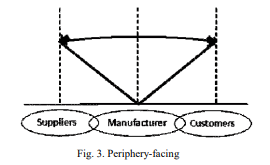
We conducted a questionnaire survey of 20 companies. According to integration arc theory, 17 of them were classified as periphery-facing, 2 as supplier-facing, and 1 as customer-facing. Among the periphery-facing companies, 7 were manufacturing-centered, 5 were food-service-centered, and 5 were retail-centered.
Periphery-facing (1): manufacturing-centered companies
Periphery-facing refers to moderate integration from suppliers to customers, as shown in Figure 3. They include suppliers (raw materials) and retailers, or have relationships with retailers/restaurants. The first producer directly supplies and sells organic vegetables to consumers, or distributes them to retailers. It does not have HALAL certification, but organic vegetables are safe and reliable for Muslims because they are Muslim-friendly.
The second producer provides fish cake products (Satsuma fried) and has not obtained HALAL certification. However, they intend to build a brand so that Muslims in Japan can eat safe and reliable fried small confectionery food by publishing food information. This is a Muslim-friendly policy. To implement this policy, they check at the time of procurement that the raw materials do not use lard and alcohol. The HALAL food production line is separated from the non-HALAL food production line. They do not use pesticides or chemical seasonings. In addition to basic checks, they also check the standard product regulations of food documents and the fishing boats that supply the raw materials. Furthermore, they emphasize the trust relationship among stakeholders, which is built through information disclosure and direct communication. They also provide information to consumers through their website and social networking services (SNS) and offer advice on cooking methods acceptable to Muslims at restaurants.
The third producer provides and sells roux flour paste and spices for curry and stew. However, they only obtain pepper made in Indonesia, which is HALAL. As part of a Muslim-friendly policy, they do not use animal ingredients to make the curry flour paste. They have also set up a consultation counter and a webpage on their website to obtain information on HALAL products.
The fourth producer provides domestically raised chickens, from rearing to processing. They have obtained NAHA's HALAL certification. According to Japan's Feed Safety Act, the domestic chickens are raised on pure vegetable feed. Muslim employees engage in the processing of the domestic chickens using the Islamic method of carbon dioxide anesthesia. They disclose all information about the HALAL process, including the rearing and processing of the chickens. They intend to make domestic chickens a famous HALAL food in Japan. In addition, they can recommend menus to restaurants and show retailers the details of processing chickens, all of which are HALAL-compliant.
The fifth producer provides bread and frozen food and has obtained JIT's HALAL certification. They focus on hygiene standards for handling raw materials, and their production line is HALAL-certified. In terms of distribution, they partly use private containers to deliver HALAL food to consumers. They also provide guidance to restaurants and retailers on how to store HALAL food.
Periphery-facing (2): food-service-centered companies
Five restaurants were considered periphery-facing. First, a curry restaurant group recently opened a HALAL curry shop. The group company has obtained NAHA HALAL certification. All the ingredients of the curry sauce (beef, chicken, vegetables, spices, etc.) are sourced in Indonesia. The curry sauce is also made and packaged there and exported to Japan. The company's website publishes the ingredients of the curry sauce and HALAL certification information.
Second, a tempura restaurant in Tokyo, Japan, is also Muslim-friendly and has not obtained HALAL certification. However, this restaurant uses HALAL-certified raw materials such as seafood, chicken, and vegetables. They focus on supplier selection and raw material procurement. Information such as tendon ingredients is published on SNS and is Muslim-friendly.
Third, a local cafe in Kobe has local HALAL certification issued by the Kyoto HALAL Association. Most of the ingredients of this cafe (beef, vegetables, etc.) are HALAL-certified, and the others are cooked according to a Muslim-friendly policy. The manager procures HALAL food raw materials directly from manufacturers to prevent HALAL food and non-HALAL food from being delivered together. The cafe has a prayer room, a 'Qibra,' and a foot-washing area, and is also HALAL-certified.
Periphery-facing (3): retail-centered companies
Five retailers were classified as periphery-facing. They control supermarkets and department stores in Japan. One of the retailers owns a supermarket chain that handles various HALAL foods such as beef, chicken, and spices. This retailer has not obtained HALAL certification, but they procure and sell HALAL-certified food. They have no criteria for selecting a certified food body, but the HALAL food supervisor selects and procures HALAL food based on quality and price.

Supplier-facing
Supplier-facing means that a company integrates its supply chain with suppliers and the degree of integration with consumers is not high, as shown in Figure 4. Two companies were regarded as supplier-facing. The first manufacturer has obtained JMA HALAL certification. They only provide HALAL-certified products (bread, noodles, condiments, etc.). When they select raw materials, they check not only the product's HALAL certificate but also the ingredients, the process flow chart, and the machinery for processing HALAL food. They sell food to retailers and consumers, but they do not provide any information about HALAL food.
Second, a small town in the Shikoku region was considered supplier-facing. The town supplies wild deer, which are processed at a factory in the town. The venison and its processing technology are NAHA-certified. Because HALAL food certification is still in its early stages, the processed venison is consumed only in this town and is not distributed to the market.
Customer-facing
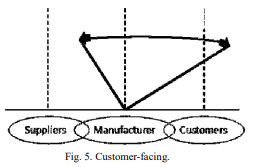
Contrary to the meaning of supplier-facing, customer-facing refers to integrating the supply chain with consumers, as shown in Figure 5. There is a manufacturer that processes and sells frozen food, corresponding exactly to customer-facing. They have not obtained HALAL certification, but based on a Muslim-friendly policy, no alcohol is used in the processing. To prevent cross-contamination with non-HALAL food, they make frozen food for Muslims in the early morning, before processing non-HALAL food. All consumers can see the ingredients and pictograms in English.