
In recent years, the Halal industry has developed rapidly worldwide. From 2016 to 2022, the Halal product market is expected to grow 28%. The Halal industry's segments have also expanded to non-Muslim regions. The Halal industry is inclusive of both Muslims and non-Muslims, so it is now very common to see Halal industry development in non-Muslim countries and regions. One obvious example is that the HFCE (Halal Food Council of Europe) has certified more than 400 European food companies. Today Halal has become a global mainstream.
As for the Halal scene in Malaysia, in 2017 Malaysia's Halal industry contributed about 7.5% of Malaysia's GDP. The huge contribution of the Halal industry to Malaysia's GDP shows that Malaysia has successfully leveraged its potential as a Muslim-majority country. Moreover, these facts will be very interesting to observe, because the Halal industry is now seen as an engine of economic growth. Therefore, this article will comprehensively examine the development of Malaysia's Halal industry. It will begin by defining the Halal industry. The next section will briefly discuss the Halal industry worldwide and will go on to outline Malaysia's Halal industry and its impact on the economy.
A. Introduction
The existence of the Halal industry has become a subject of debate for some groups. Some believe the Halal industry emerged only for economic purposes. Others believe that its existence is a response to the demand for Halal products, forcing the Halal industry to expand its scope to various products and services such as pharmaceuticals, cosmetics, tourism, finance and even fashion. This phenomenon is due to increased Muslim awareness of what can and cannot be consumed. In fact, this economic growth is very helpful to Muslims. Another factor making the Halal industry a big business is the estimated growth of the Muslim population. According to the Pew Research Centre, the global Muslim population is expected to grow 75%, from 1.6 billion in 2010 to 2.8 billion in 2050. According to the Oxford Dictionary, the term Halal can be defined as meat slaughtered according to Muslim law. It also refers to things acceptable according to Muslim Halal regulations. Based on these two definitions, Halal refers to a set of dietary regulations based on Muslim law that help Muslims distinguish what to eat, use or consume; the substances and processes for making products or providing services are also determining factors in whether a product or service is Halal. Based on the above explanation, the Halal industry can be defined as the industry that conducts business according to Halal regulations.
In producing Halal products, two things must be considered: substance and process. According to Halal law, some substances are naturally forbidden, such as dogs and pork. And other non-forbidden substances must undergo several processes to become Halal. For example, a cow must be slaughtered according to Halal procedures before being eaten by Muslims; otherwise it will be forbidden to eat. This concept applies to any form of food and consumer goods, including cosmetics, personal care products and pharmaceuticals. It also applies to trade or commercial processes and service-industry activities.
As the Muslim population is estimated to increase, future demand for the Halal industry may grow. According to the Pew Research Centre, the global Muslim population is expected to grow 75%, from 1.6 billion in 2010 to 2.8 billion in 2050. The growing demand for Halal products forces the Halal industry to expand its scope to various products and services such as pharmaceuticals, cosmetics, tourism, finance and even fashion.
B. Overview of the world Halal industry
Halal product spending can serve as one indicator for measuring the development of the world Halal industry. According to the 'State of the Global Islamic Economy Report 2019/2020' published by DinarStandard, from 2018 to 2024, global Halal product spending may increase, with an expected compound annual growth rate of 6.2%. The table below shows the expected growth in global spending or assets in 6 different economic sectors from 2018 to 2024.
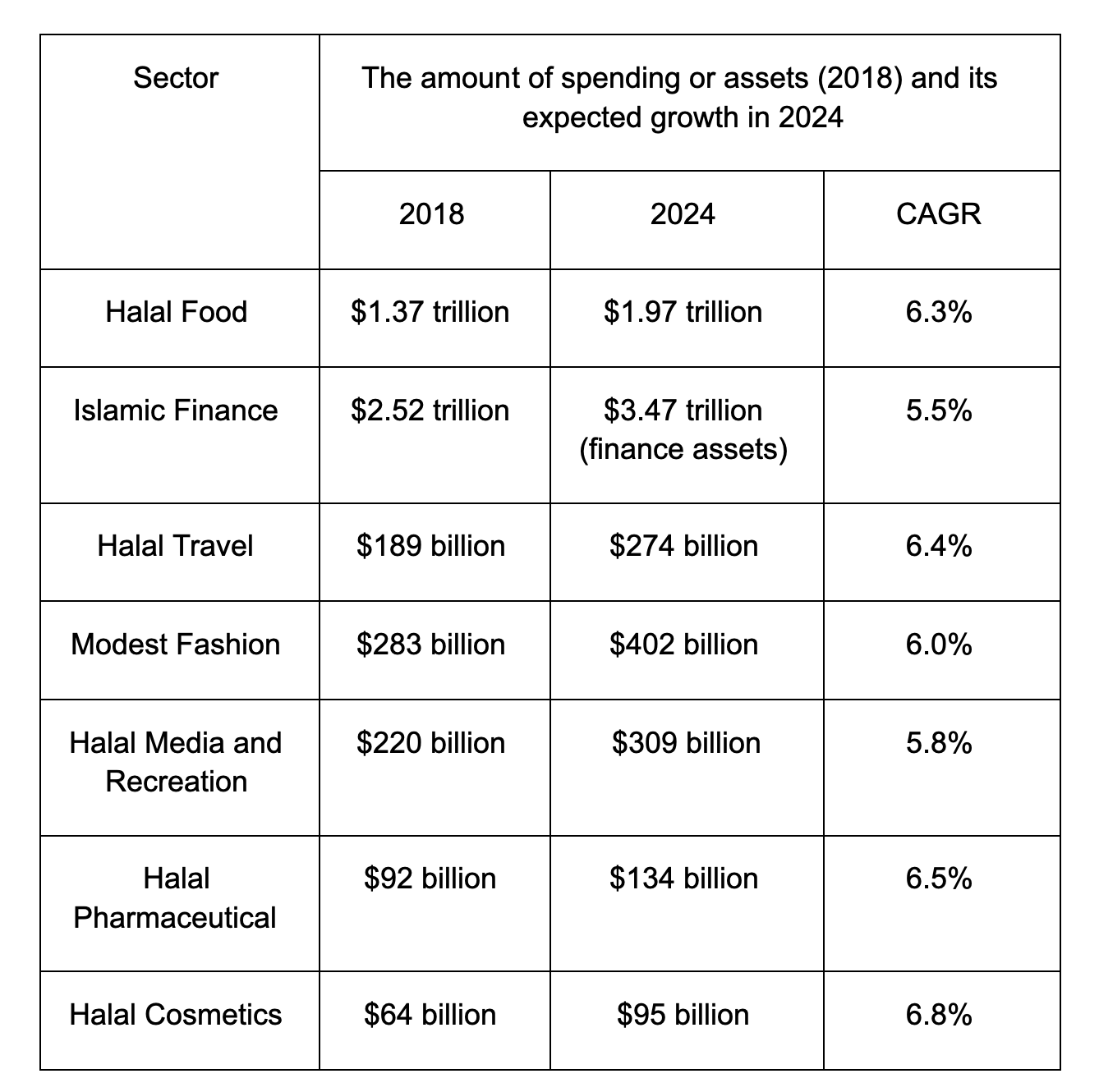
As can be seen from the table above, all economic sectors of the Halal industry will have a positive trend in the near future, with growth rates no lower than 5.5%. Although the main consumers of Halal products are the Muslim populations of Muslim-majority countries, some sectors in the table above are mainly Muslim-minority countries. For example, in Halal food, Brazil and Australia are the main countries exporting meat and live animals to Organisation of Islamic Cooperation (OIC) countries, with exports of US$5.5 billion and US$2.4 billion respectively. Despite ranking among the top in other countries, Brazil still faces the problem of non-compliance with Halal standards. In March 2017, Brazil's federal police announced that allegedly influential meat companies paid health officials to ignore various abuses that could endanger the safety and certification of food shipped to every corner of the world. After the scandal, Saudi Arabia immediately suspended imports of Brazilian beef and poultry (Newsweek). To solve this problem, standards generally accepted by global certification bodies must be developed to avoid duplicate certification costs and reduce complexity (State of the Global Islamic Economy Report 2018/19).
In addition, in Halal clothing, 'Made in China' products top the list of Halal clothing exporters to OIC countries, valued at US$10.6 billion. This amount is far ahead of the second place, with India leading at US$3.1 billion, followed by Turkey at US$2.3 billion. China also plays an important role in Halal fashion exports. This part is mainly divided into three sections: a) toys, games and sports, b) printed books, newspapers and pictures, and c) photographic or cinematographic supplies. China leads with US$3.6 billion, followed by the US at US$556 million, and the UK in third at US$450 million. The same goes for the next two sectors, Halal pharmaceuticals and Halal cosmetics, where the dominance among OIC exporters still belongs to Western countries. The top 5 countries exporting Halal cosmetics to OIC countries are France (US$2.6 billion), the UAE (US$1.2 billion), Germany (US$1.1 billion), the US (US$1 billion) and China (US$0.8 billion).
The dominance of some Muslim-minority countries, especially in the economic sectors of the Halal industry, clearly shows that even in countries with smaller Muslim populations, there is still room for Halal industry development.
C. Malaysia's Halal industry and its impact on Malaysia's economy
The development of Malaysia's Halal industry began in 1974, when the Islamic Affairs Research Center began issuing Halal certificates. Over the years, the country has recognized the urgency and potential of the Halal industry. The Halal Industry Development Corporation was established in 2006, showing Malaysia's strong willingness to become a Halal industry leader. The body is affiliated with the Ministry of Economic Affairs and is responsible for coordinating the overall development of Malaysia's Halal industry (HDC Global).
The government's support for promoting Malaysia's Halal industry is evident. The latest and most obvious evidence is the 2008-2020 Halal Industry Master Plan (HIMP), whose vision is to build Malaysia into a global Halal hub. The expected outcome of this policy is to make Halal a new source of economic growth (MITI). In addition, Malaysia hosts the two most important annual events in the Halal industry, namely the Malaysia International Halal Showcase (MIHAS) and the World Halal Forum (WHF). Since 2003, both have played a key role in establishing the country's reputation as a global reference and trade hub for the new mainstream Halal industry (Tourism Malaysia 2020). In addition, Malaysia's seriousness as a global Halal hub is also reflected in the establishment of Halal Parks, which are communities of manufacturing and service enterprises located on public property, aimed at maintaining the integrity of Halal products. From 2010 to 2017, the total investment in Halal Parks reached RM 13.27 billion, and a total of 14 Halmas were received nationwide in Malaysia. Halmas is a certification for Halal Park operators who have successfully complied with the requirements and guidelines for Halal Park development designated by HDC. In this regard, the Malaysian government has formulated tax incentive policies to increase the attractiveness of Halal Parks for certain products, such as livestock and meat production, probiotics, special processed food, pharmaceuticals and nutraceuticals, cosmetics and personal care, and Halal ingredients (HDC Global).
The results of the Malaysian government's promotion of Halal industry development can be seen from two aspects: the contribution to GDP and the value of Halal exports. In terms of contribution to Malaysia's GDP, the Halal industry has shown a positive trend in recent years. Dr. Khalid Abdul Hamid, director of the services division of the Ministry of Economic Affairs (the Star, 2019), said that in 2017, the contribution to Malaysia's GDP was 7.5%, and was expected to grow by 1.2% this year, possibly reaching 8.7%.
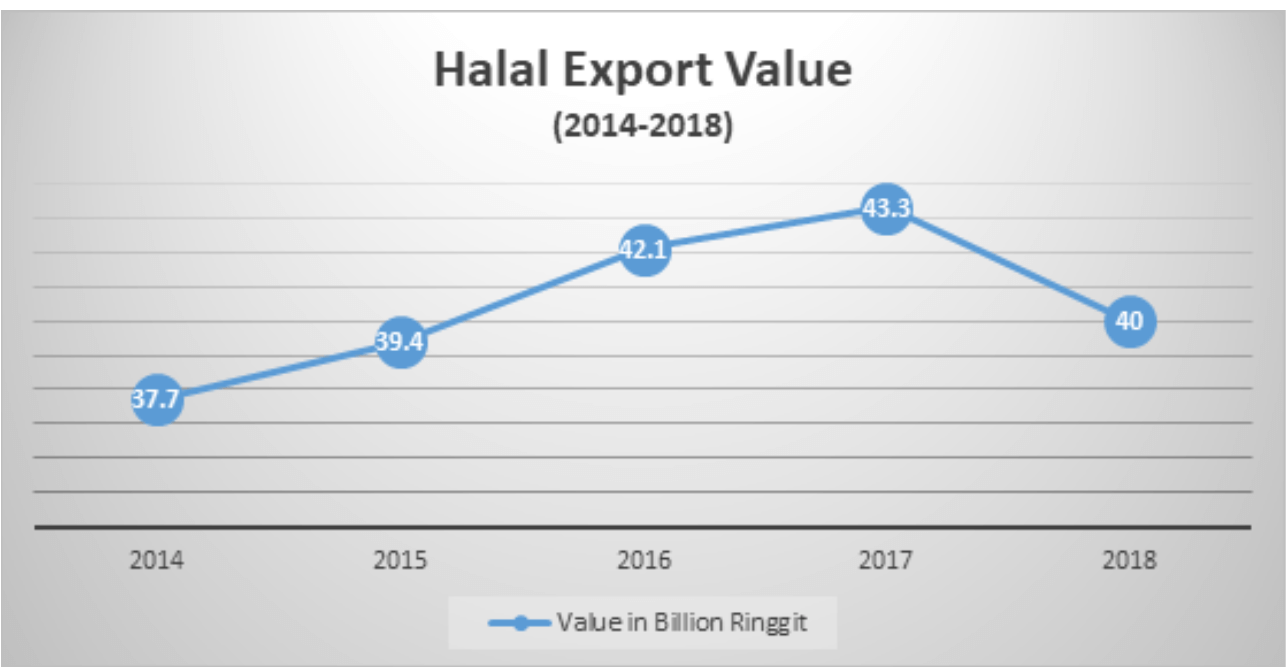
In terms of Halal exports, from 2010 to 2018, the volume of Malaysia's Halal exports gradually increased. However, Hanisofian Alias said that in 2018, due to a challenging time for the palm oil industry, including lower palm oil derivatives, the index declined slightly from the previous year (The Malaysian Reserve, 2019). The table below shows the value of Malaysia's Halal exports from 2014 to 2018.
Source: Halal Industry Development Corporation (HDC).
Although Halal exports increased in 2017 compared with the previous year, the proportion of Halal exports in Malaysia's total export value declined for two consecutive years thereafter. This is due to the rapid growth of Malaysia's total export value. In 2016, the contribution to Malaysia's total exports was 5.3%, with total exports of RM 787 billion. In the next two years: RM 935.4 billion, accounting for 4.6%, and RM 998 billion, accounting for 4.0%.
In addition, the Malaysian government's full support for Halal industry development has made Malaysia the leading country in the Global Islamic Economy Indicator. This indicator comprehensively reflects which countries are currently best able to seize the trillion-dollar global opportunity. It measures the Islamic economic strength of 73 countries, involving supply and demand drivers, governance, awareness and social factors, and is a weighted combination of 49 important indicators (State of the Global Islamic Economy Report 2019/20). Two Middle Eastern countries follow Malaysia in first place, with the UAE in second and Bahrain in third.
Conclusion
The world has recognized that the Halal industry is a new engine of economic growth. This can be seen from the increase in Halal products in many countries, not limited to Muslim-majority countries. In fact, Halal is not regarded by users as merely a label. Using the Halal label indicates that certain products have good standards and quality. Many countries have recognized the urgency and potential of the Halal industry and are now competing to become the best Halal product suppliers. This is also in response to the gradually increasing market demand in recent years.
In addition, over the next four years, the consumption of Halal products worldwide will increase. It is predicted that even countries with smaller Muslim populations will be major players in the Halal industry. For example, Brazil and China will be major exporters of Halal meat and clothing to OIC countries.
Malaysia, as the world's leading country in the Global Islamic Economy Indicator, has had a long history of Halal industry development since 1974. Through the Halal Industry Master Plan (2008-2020), Malaysia aims to become a global Halal hub. To achieve this goal, the Halal Industry Development Corporation (HDC) was established, and one bold action under HDC's leadership was the establishment of Halal Parks. In fact, HDC has made a positive contribution to the growth of Malaysia's Halal export value. Halal exports grew substantially by 163%, from RM 15.2 billion in 2010 to RM 40 billion in 2018. It will help the country have greater competitive advantage, bringing higher wages and more employment opportunities. In addition, the Halal industry's contribution to Malaysia's GDP is expected to increase from 7.5% two years ago to 8.7% in 2020, which also emphasizes the importance of HDC. Moreover, Halal Parks and their tax incentive policies have contributed to substantial investment in the Halal industry, RM 13.27 billion from 2010 to 2017. It has a total of 14 Halmas (Halal Park operators) nationwide in Malaysia. This means Halal Parks bring more employment opportunities. In addition, Malaysia must maintain this positive trend and intensify its efforts to always respond to market demand.