
3. HALAL certification in Japan
1. Muslim-friendly
Companies in Japan must obtain HALAL certification to provide HALAL food to stakeholders including customers. However, even if they do not obtain HALAL certification, they can provide 'Muslim-friendly' food and venues according to HALAL regulations.
2. Certification bodies
HALAL certification
The philosophy of the HALAL certification system is 'from farm to table.' All stages of the food supply chain, including raw materials, processing and distribution, should be HALAL. As shown in Figure 1, the flow of HALAL food is the same as the general food supply chain.
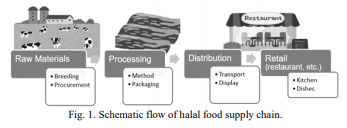
For HALAL certification, there are some HALAL-regulation-based provisions at each stage of the food supply chain. Companies obtain certification by meeting the HALAL food regulations of a HALAL certification body. To obtain HALAL certification, a company must meet the following criteria:
- Avoid all parts of fanged animals such as pigs and dogs, including pig extracts and additives such as pork components extracted from them.
- HALAL regulations handle any animal.
- Avoid eating meat not processed under HALAL regulations, as well as animal blood and animal carcasses.
- Avoid alcohol, alcohol-containing components and alcohol-containing condiments. However, a small proportion of alcohol component depends on the HALAL school of law.
- Avoid using chemical seasonings during processing and cooking.
At the raw-material preparation stage, livestock on the farm should be isolated from pigs and raised with feed that complies with HALAL regulations. At the processing stage, animal fats and oils cannot be used in processing and packaging materials. Processing materials should be isolated from non-HALAL products such as pork. Spices and seasonings must be HALAL. At the distribution stage, HALAL products should be isolated from non-HALAL products in containers and warehouses. They should be stored and displayed separately from non-HALAL products. The HALAL certification system is region-dependent. For example, in Malaysia, a factory producing HALAL products should face Mecca and be more than 5 km away from pig farms and sewage treatment facilities.
HALAL certification bodies
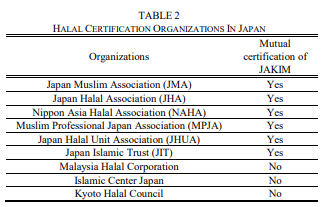
Currently, Japan has 9 HALAL certification bodies, as shown in Table 2. Six of them have mutual recognition with the Malaysian government HALAL certification body (JAKIM). JAKIM allows mutual recognition with 67 bodies in 49 countries. The Japan Muslim Association (JMA) and the Japan Halal Association (JHA) had previously been certified by JAKIM. The other 4 bodies (NAHA, MPJA, JHUA, JIT) were successively certified from February 2017. There are also 3 bodies without JAKIM mutual recognition; therefore, they only have local HALAL certification.
Examples of Japanese HALAL certification guidelines
1) Nippon Asia Halal Association (NAHA)
NAHA has obtained mutual recognition from Malaysia's JAKIM and Singapore's MUIS. HALAL certification has Muslim experts serve as auditors. They certify unprocessed, additive-free vegetables (grains, eggs, milk, rice, etc.), processed food and beverages. The certification fee is 100,000 yen (about US$885) or less, valid for 2 years.
Japan also promotes a 'Muslim-friendly' policy. They define it as 'a facility or environment that is satisfactory for the HALAL food preparation part.' The audit items include: (1) raw materials, (2) dishes and cookware, (3) the role of employees, (4) the responsibilities of managers, (5) restaurant conditions, (6) hotel conditions, (7) cleaning, hygiene and food safety.
2) Japan Islamic Trust (JIT)
JIT has obtained mutual recognition from Malaysia (JAKIM), the United Arab Emirates, Qatar and Thailand. They put forward the philosophy of the three H's (HALAL, Hygiene, Health). Certification is carried out through inspection and discussion of manufacturing and processing facilities. If there is anything to improve in raw materials and manufacturing processes, they provide suggestions for obtaining HALAL certification. In any case, they consult experts for detailed opinions on HALAL legal views. If five products are produced in the same factory, the certification fee is 300,000 yen (about US$2,655). Each additional product requires an extra fee of 20,000 yen (about US$117). The validity period is one year.
3) Kyoto Halal Council
They are a local HALAL certification body, but they have obtained mutual recognition from Qatar and Thailand. Their certification is divided into several stages and has a different view from JAKIM.
(1) Restaurant/shop certification. They can certify a restaurant or shop as HALAL. (2) Menu certification. They advise on the composition of the menu to provide HALAL food for Muslims. If the menu meets the required conditions, it will be certified as HALAL. For example, a restaurant or shop serving alcohol will not be certified as HALAL. However, if the menu provides food for Muslims, its menu is certified as HALAL. (3) Halal-stay certification. They can certify a hotel or conference hall as HALAL for Muslim tourists. For example, a hotel or conference hall providing prayer mats, HALAL facilities, prayer rooms, etc. will be certified. (4) Product certification. They can certify a specific product as HALAL (e.g. handicrafts made with Japanese historical techniques). (5) Zabuhu support. 'Zabuhu' refers to meat being properly processed into HALAL food according to Islamic law. A Zabuhu expert with appropriate knowledge and experience needs to be dispatched to carry out certification. (6) 'Qibla' arrangement.
FAQ
- Do companies in Japan need HALAL certification to serve the halal food market?
- According to the article, a company in Japan that wants to provide halal food to its stakeholders generally needs HALAL certification; even without it, a business may offer 'halal-friendly' food and facilities in line with halal rules. The two differ in standing — a formal certification issued by a certification body carries more credibility.
- Which HALAL certification bodies operate in Japan, and how do they relate to Malaysia's JAKIM?
- Per the article, Japan has about nine HALAL certification bodies, six of which hold mutual recognition with Malaysia's official body JAKIM (e.g. JMA, JHA, plus NAHA, MPJA, JHUA, JIT). JAKIM recognizes 67 bodies across 49 countries; mutual recognition makes a certification more readily accepted across markets.
- How much does one HALAL certification in Japan cost?
- Per the article's examples, fees vary by body and number of products: the Nippon Asia Halal Association (NAHA) charges about JPY 100,000 (roughly USD 885), valid for two years; the Japan Islamic Trust (JIT) charges about JPY 300,000 (roughly USD 2,655) for five products at one plant, with more per additional product. Confirm with the certification body.
- What does HALAL certification require across the food supply chain?
- Per the article, the principle is 'farm to table': at the raw-material stage, livestock are kept separate from swine and fed compliant feed; in processing, animal fats are not used and products are isolated from non-halal items such as pork; in distribution, halal products are stored and displayed separately from non-halal ones.
- What is the difference between 'halal-friendly' and formal HALAL certification?
- Per the article, 'halal-friendly' refers to a facility or environment that partly satisfies halal food preparation — audits cover raw materials, utensils, staff roles, management, restaurant or hotel conditions, cleaning and food safety. It has a lower bar and is not equivalent to a HALAL certification issued by a certification body.