
Analysis by the global consulting firm AT Kearney found that the global Halal market will surpass US$2.5 trillion for the first time in 2020, and will continue to grow to US$3 trillion over the next five years.
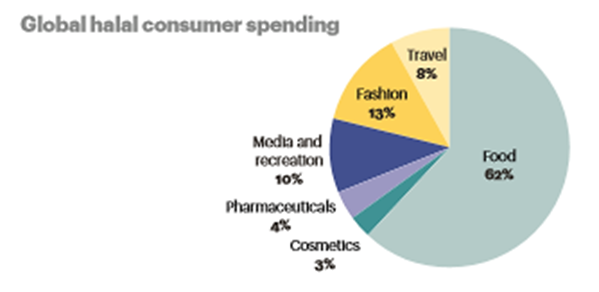
The company's Global Business Policy Council conducted an analysis and found that by 2023, global spending on Halal products and services will nearly double. In 2012, the Halal market accounted for US$1.6 trillion of global consumer spending, and in 2017 it accounted for 4.5% of global consumer spending at US$2.1 trillion. With the market expected to reach US$3 trillion by 2023, it is growing exponentially.
The Halal market consists of products acceptable under Halal certification regulations and consistent with Muslim culture. At present, the Halal market includes six main areas: food, travel, fashion, media and entertainment, pharmaceuticals and cosmetics. Currently, food occupies the major share of the market at 62%, while other areas such as fashion (13%) and media (10%) are also continuously developing to attract more and more consumers.
Although it accounted for only 8% of the global Halal market in 2017, Halal tourism will also grow as hotels and tour operators race to meet the dietary needs of Muslim travelers. The Halal travel company HalalBooking raised US$2 million in a recent funding round, an early example of the development of the tourism industry.
The global Halal market continues to be concentrated in countries with the largest Muslim populations, especially Indonesia. Under the regulations mandating Halal labeling on consumer goods in the region since October 2019, Indonesia will become the global Halal center.
That said, major Western markets, especially the Halal food sector, will also see significant growth. Haribo has already opened a Halal candy store in London, and Mitsubishi has invested in the UAE's Al Islami Foods, so further investment by multinational companies is expected in 2020 and beyond.
Bahige El-Rayes, a partner at AT Kearney, said: 'The Muslim population makes up nearly a quarter of the world's population, and as a consumer group it occupies a large proportion of the market. Businesses, especially those in Western countries, should note that there is now a clear opportunity to invest in Halal products and services and capitalize on this rapidly growing market.'