
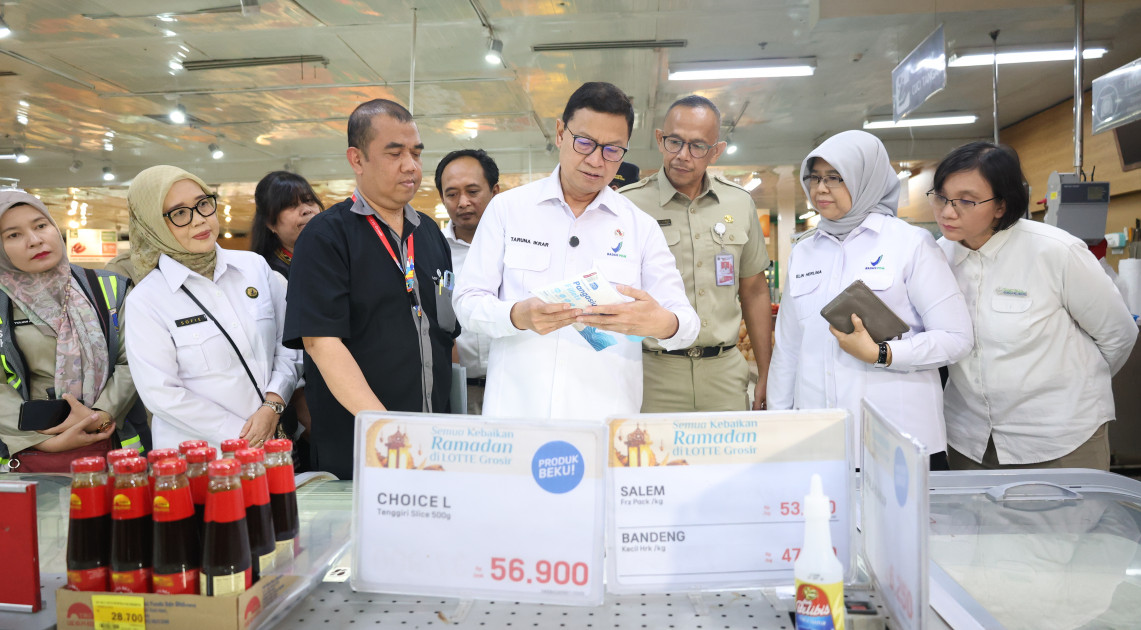
JAKARTA — Indonesia's National Agency of Drug and Food Control (BPOM) and the Jakarta Special Capital Region government reaffirmed their commitment to strengthening food oversight during Ramadan and ahead of Eid al-Fitr 1447H in order to protect public health. On Monday, March 9, 2026, BPOM head Taruna Ikrar personally led a team on a marathon working visit to two strategic locations in the capital: the production facility of PT Mustika Citra Rasa (Holland Bakery) in North Jakarta, and the Lotte Grosir wholesale market Pasar Rebo outlet in East Jakarta. The measure was taken to ensure the safety and quality of food during Ramadan and Eid, when public demand is expected to grow sharply by up to 400%.
The visit began at the Holland Bakery factory. The BPOM head and his party were received by PT Mustika Citra Rasa general manager Paulus Tjakrakusuma and his team, and toured the production facility. The BPOM head directly supervised the ongoing implementation of Good Processed Food Manufacturing Practices (CPPOB) through monitoring of corrective and preventive actions (CAPA).
The BPOM head said that maintaining the safety standards of the national food industry is crucial to supporting the 8% economic growth target toward the Golden Indonesia 2045 vision. "Effective oversight is carried out not only through inspection, but also through partnership between government and industry. Through a commitment to openness, transparency and continuous improvement, we build consumer trust while providing the best protection for the public," Taruna Ikrar stressed before the Holland Bakery management.
After inspecting the production upstream, monitoring continued to the downstream Lotte Grosir wholesale market Pasar Rebo outlet, accompanied by Hasudungan A. Sidabalok, head of the Jakarta Special Capital Region Food Security, Marine and Agriculture Office (KPKP). Monitoring of the retail facility was aimed at checking the implementation of Good Processed Food Distribution Practices (CPerPOB).
During the inspection, BPOM found that the frozen warehouse was over capacity (overloaded). The BPOM head reminded management to make immediate improvements. "We just checked the product's distribution license, labels and packaging, including the expiry date. In addition, an overloaded cold store can raise the indoor temperature, causing the food stored in it to spoil faster. Operators must not ignore public health for economic motives or a desire to clear stock," he said.
Nationwide, the intensification of food oversight in 2026 has entered its third phase, with a total of 1,134 distribution facilities inspected, up 25% from the previous year. As a result, 56,027 non-compliant (TMK) food items were found, because they were expired, damaged or lacked a distribution license (TIE) — a figure that jumped 83% from the same period last year. In the Jakarta Special Capital Region, of the 18 facilities inspected, 9 were non-compliant, with the main finding being illegal snacks. Besides packaged food, BPOM also tested 222 samples of Eid snacks in Jakarta. BPOM found 10 samples (4.5%) proven to contain harmful substances, including Rhodamine B in rice cakes and prawn crackers, and formaldehyde in yellow noodles and tofu.
Jakarta Special Capital Region Secretary Uus Kuswanto, who accompanied the visit, expressed full support for BPOM's decisive action. "We welcome this cooperation, because Jakarta's residents need certainty about health essentials. This direct oversight reassures residents that they need not worry about consuming food during Ramadan and Eid. We ensure that violating traders will receive guidance and that dangerous products will be destroyed immediately," Uus Kuswanto said. Elisabeth Ratu Rante Allo, head of the Jakarta Special Capital Region Office of Industry, Trade, Cooperatives and SMEs (PPKUKM), also expressed willingness to cooperate to ensure food safety within the region.
During the inspection of the Lotte Grosir wholesale market, BPOM head Taruna Ikrar spoke with several consumers and promoted the "Cek KLIK" slogan to them directly. Taruna Ikrar also emphasized the importance of the public becoming smart consumers. Demonstrating how to ensure product safety by scanning a barcode with an app, he explained that consumers must check the packaging, label, distribution license and expiry date.
"Ma'am, there is a way to make sure your shopping is compliant: check the packaging, label and distribution license number. Finally, most importantly, the expiry date, because healthy food can turn into poison if it has already spoiled or grown bacteria due to an expired date," Taruna Ikrar explained while verifying that the product, safe until September 24, 2026, was still good.
In conversation with consumers, Taruna Ikrar also asked how they usually choose food to prepare for eating at home and for gift hampers. Taruna Ikrar called on the public to always stay vigilant and strictly follow the Cek KLIK principle, which was warmly welcomed by consumers. (HM-Syale)
FAQ
- How did Indonesia's BPOM strengthen food oversight during Ramadan and Eid al-Fitr?
- Indonesia's National Agency of Drug and Food Control (BPOM) and the Jakarta Special Capital Region government strengthened food oversight during Ramadan and ahead of Eid al-Fitr 1447H to protect public health, with public demand expected to surge by up to 400%. In 2026, the nationwide intensification of food oversight entered its third phase, inspecting 1,134 distribution facilities (up 25% year-on-year) and finding 56,027 non-compliant food items that were expired, damaged or lacked a distribution license (up 83% from the same period last year). Besides packaged food, BPOM tested 222 samples of Eid snacks in Jakarta and found 10 samples (4.5%) containing harmful substances, including Rhodamine B in rice cakes and prawn crackers and formaldehyde in yellow noodles and tofu. The BPOM head also reminded operators not to overload cold storage, as this can raise the temperature and cause food to spoil faster.