
What most often stops Chinese products at the border is a technical barrier to trade, and certification is the blade that cuts through it. Different markets recognize different certificates — for food & beverage, cosmetics, and pharmaceuticals, entering Indonesia means BPJPH Halal and BPOM registration; entering the US and Europe requires meeting FDA and EU rules and earning food-safety system certifications such as HACCP/IFS/BRC; premium retailers often also require Kosher certification; and the Gulf market demands GSO compliance alongside Halal. This guide puts the four certification families that food & beverage, cosmetics, and pharmaceutical companies meet most often when going global — Halal, Kosher, Vegan, and food-drug/market-access — on a single map.
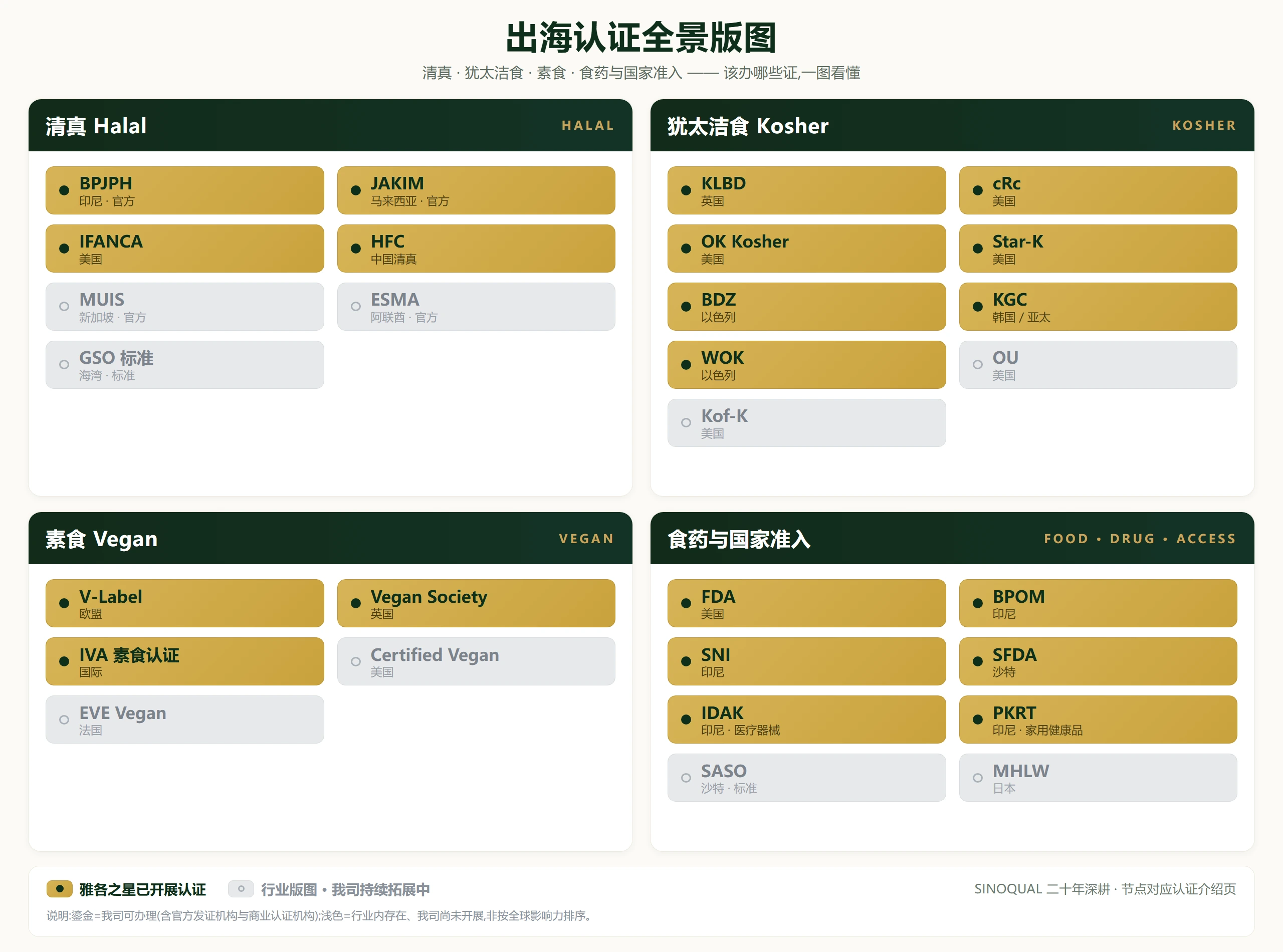
Tap a certification below to open its page (some agency authorizations have no standalone page yet, shown in light):
1. Why certification, not product, is the bottleneck
Anyone in export trade has hit this: samples done, price agreed, customer ready — and at shipment, "no XX certification, can't enter." In many markets certification is a hard gate, not a nice-to-have: without it goods are held at customs, kept off shelves, or delisted by platforms.
Worse, markets don't recognize one universal certificate. The same goods need Halal for Indonesia, Kosher for some US retailers, Gulf-standard compliance for the Middle East. The most common first-time question is "which certificate do I need" — that's what this guide answers.
2. The four certification families
3. Look up by target market: which certificates do I need
The most practical view is the reverse — pick the market, then see what it requires (always confirm against your product category and the latest regulation):
A common myth: that one Halal certificate sells across all Halal markets. In reality Indonesia recognizes BPJPH, Malaysia recognizes JAKIM; bodies and mutual recognition differ — confirm market by market.
4. Where SINOQUAL sits on this map
Stack the four families and you get a going-global certification map. SINOQUAL has focused on international certification since 2006 — two decades — and today runs services across all four families:
In Indonesia, SINOQUAL is authorized by PT SUCOFINDO — the leading Halal inspection body (LPH Utama) recognized by Indonesia's BPJPH — to carry out Indonesia Halal certification audits from within China. Over two decades it has helped 6000+ companies reach global markets across food, pharmaceuticals, cosmetics, chemicals, supplements and packaging.
5. Closing
Going-global certification looks tangled but the logic is simple: decide the target market, match it against that market's mandatory and high-frequency certifications, and prepare each to spec. The hard part is rarely "what to file" but "how to get it right the first time" — especially system-document preparation and coordinating multiple certificates at once. If you're preparing to sell into an overseas market but aren't sure which certificates apply or where to start, tell our certification advisors your product and target market and we'll map out a path for your case.
FAQ
- What's the step that most often trips up a first-time certification?
- Usually not the product but the production-system documentation — material traceability, anti-cross-contamination, Halal production procedures, internal-audit records. Indonesia's BPJPH SJPH system scrutinizes this; weak preparation is the main reason applications are returned and timelines drag.
- Does one Halal certificate let me sell across all Halal markets?
- No. There is no single global Halal certificate. Indonesia recognizes BPJPH, Malaysia recognizes JAKIM; standards and mutual recognition differ, so confirm market by market.
- What certificates does my product need for Indonesia?
- Typically BPJPH Halal (mandatory for food/cosmetics) plus BPOM registration, with SNI for some categories. Confirm against your product type and the latest regulation.
- My buyers don't keep Kosher — why get Kosher certified?
- Many premium Western retailers and food-ingredient buyers read the Kosher mark as a strict quality-control signal and require suppliers to hold it; in those channels it is a hidden gate.