
The Food Innovation and Resource Centre (FIRC) attended the Halal seminar held by Singapore's MUIS at its new office location-Singapore Integrated Building at 273 Braddell Road. This year's Halal seminar theme was 'Strengthening Assurance, Broadening the Halal Market,' with guest of honor Dr. Yaacob Ibrahim, who concurrently serves as Minister for the Environment and Water Resources and Minister-in-charge of Muslim Affairs. In his keynote speech, Dr. Ibrahim said that local businesses regard Halal certification as a key assurance for entering and expanding overseas markets, especially the Middle East market. Singapore's food-service industry exports to the UAE-our largest food trading partner-increased by 67% in 2007, reaching US$170 million.
Afterwards, Dr. Ibrahim, MUIS Chief Executive Haji Alami Musa, and Singapore Mufti Syed Isa bin Mohamed were invited on stage to launch the latest revised version of the MUIS certificate. The new certificate uses different color schemes for different schemes and adds security measures such as anti-copying and anti-piracy watermarks to prevent theft and misuse of the certificate.

MUIS Halal Certification Director Dewi Hartaty Suratty briefly introduced the latest developments in MUIS Halal certification. MUIS's current top strategic goal is to rank among the world's best Halal certification authorities. To better implement Halal standards, MUIS recently introduced the Halal Quality Management System (HalMQ). HalMQ has the same status as the other two global certifications, ISO and HACCP, and is now well known to many companies. By January 2010, the HalMQ standard will be fully implemented. MUIS Halal certification is now formally recognized in key markets such as Brunei, Indonesia, Malaysia, Singapore, the UAE, Qatar, and Kuwait. In addition, the use of natural ethanol and natural colorant E120 in the production of Halal spices was approved after reconsideration by jurists.
Another exciting development is the upcoming 'whole-plant' Halal certification scheme, targeting companies whose products all meet Halal standards. They hope to certify their factories as a whole so that all their products can use the Halal mark. Doing so can reduce the budget, improve competitiveness, and build credibility-many benefits.
Some food manufacturers and food-service chains that have successfully introduced and implemented the HalMQ standard were invited to share their experience in implementing the HalMQ scheme and using the influence of Halal certification to broaden the market. These companies include Abbott Singapore, Lao Zeng Ji, T&T Gourmet City Pte Ltd, Jumain Sataysfaction, the Carousel restaurant, and Pastamania. Each company summarized, from its own perspective, the challenges encountered in implementing HalMQ and the benefits gained after implementing this standard.
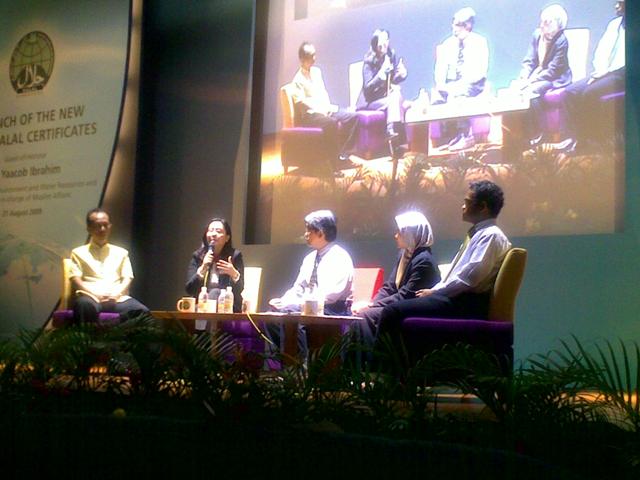
The seminar concluded successfully after two rounds of discussion. Most questions were directed at Dewi. A concerned audience member pointed out that the Carousel restaurant still serves alcoholic beverages and questioned whether its Halal certificate was valid. Dewi pointed out that the Carousel restaurant only chose to guarantee Halal catering for specific private rooms rather than the entire restaurant, so it could sell alcohol. The Carousel restaurant's head chef Ibrahim Tan added that the dining area was well separated so that Muslim customers would not be troubled by the presence of alcohol. There was also great interest in the whole-plant certification scheme. Dewi said that more details would be announced before the scheme's implementation in October.