Wang Zhengwei: Doing business with the Middle East starting from the halal industry - CCTV2 report
The Hui population of the Ningxia Hui Autonomous Region accounts for one-fifth of the country's Hui population, but in the past Ningxia did not make this a main thread of economic development. Now Ningxia increasingly recognizes that the Muslim economy is a vast market with broad global prospects, and it has decided to fully launch economic and trade cooperation with Arab countries to build a Muslim economy with Ningxia characteristics. The 2010 First China-Arab States Economic and Trade Forum in September this year will also be held in Ningxia. So just how big is the Muslim-economy market, and how will Ningxia tap the business opportunities within it? Yesterday, a reporter from the finance channel had an exclusive interview with Wang Zhengwei, Chairman of the Government of the Ningxia Hui Autonomous Region.
Reporter Siqin: 'Hello, Chairman!'
Chairman Wang Zhengwei: 'Hello!'
Reporter Siqin: 'Chairman, what I am holding is a very beautiful piece of our Hui ethnic clothing. It is produced in Ningxia's Muslim Goods Industrial Park, and it will soon be sold to the Arab market. So, what is the scale of Ningxia's Halal industry now, and what is its future goal?'
Doing business with people in the Middle East starting from the Halal industry!
Halal food and Hui clothing have huge market potential
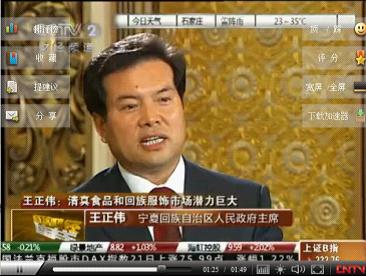
Chairman Wang Zhengwei: 'In doing business with the Arab countries of the Middle East, we first take the Halal industry as the entry point, because in this way there may be many things with a common language and some common customs. For example, our two industries of "clothing" and "food" have now entered the Arab countries of the Middle East; our Halal food has already entered the markets of Malaysia and Egypt. In Egypt you can see the "Saishang Jiangnan Halal Restaurant"—that is run by Ningxia people. At the same time there is a hall showcasing Ningxia clothing. This shows that our Halal food and Hui clothing have huge market prospects. For example, an Arab wears four robes a year, so his consumption market is also large, and his women consume even more than the men, so clothing is also a big market.'