
PP JPH was signed by the President on 29 April 2019 and promulgated on 3 May 2019. However, a copy of PP JPH has not yet been released, pending a government press release.
The content of the PP is more general regarding inter-ministerial and inter-agency cooperation, LPH, international cooperation, etc. The technical rules for Halal implementation will be regulated in a ministerial regulation (Peraturan Menteri Agama / PMA).
The PP JPH derivative regulations are currently under discussion; Apindo and the Vice President's office will assist the association in supervising the PMA. The PP JPH derivatives will have 3 regulations, namely:
- PMA on preliminary Halal certification
- PMA on the implementation of Halal certification
- Ministry of Finance regulation on tariffs/fees (Peraturan Menteri Kewangan / PMK)
All products included in the definition of 'product' in the JPH law must be Halal-certified. Among the goods used, those that must be Halal-certified are goods containing animal elements. Other items not included in the 'product' category of the UU JPH (such as refrigerators, pens, etc.) will be rejected by BPJPH if Halal certification is applied for.
The entire Halal (end-to-end) certification process is under BPJPH. MUI's role in the certification process is to issue the ruling.
Some key points related to Halal implementation in the PMA are as follows:
The Halal certification obligation began in October 2019, with transition phases ranging from 7 to 15 years for all categories such as medical devices, pharmaceuticals, biologics, and food and beverages.
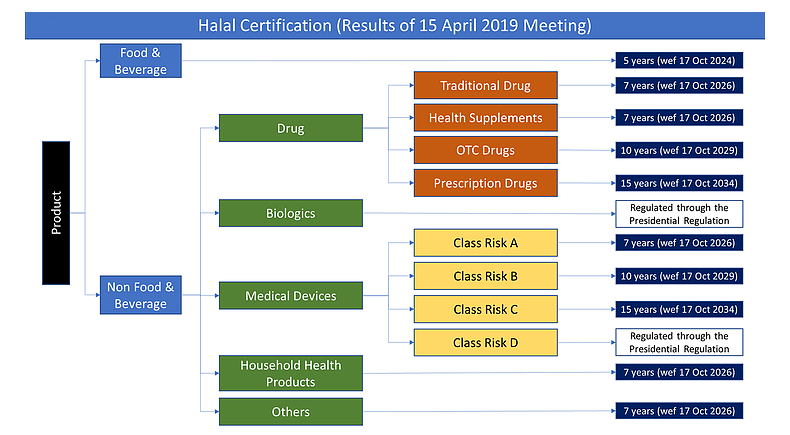
1. During the transition period, products not Halal-certified may circulate in Indonesia without certain labels.
2. After the transition period, all products must be Halal-certified and labeled on the packaging as specified by the PMA. There will be two types of products on the market:
(1) Halal-certified products
(2) Products not Halal-certified (non-Halal-certified)
All products must first go through the Halal certification process.
3. Products that are not Halal-certified may still circulate on the market with a special label:
Non-pharmaceutical categories: certain logos/information will be arranged in the PMA
- Pharmaceutical category: highlighted in red in the ingredients.
4. BPJPH will recognize the foreign certification bodies currently recognized by MUI. In the future, BPJPH will add to the list of recognized foreign bodies.
5. In the future, the Halal certification process can also be carried out through BPOM, which will have a representative on behalf of BPJPH. When renewing the NIE registration, the business representative can simultaneously submit the Halal certification registration.
6. Halal and non-Halal separation must be carried out during the production process, up to the packaging process. After packaging, products can be stored, distributed and sold together without special separation.
7. The PMA will not regulate the separation of the display of packaged Halal products from non-Halal products.
Next steps for Apindo:
1. Publish 'Smart Books' on Halal certification in the local language. This will be done through the PMA and the association.
2. Distribute Halal food regulations to association/enterprise representatives.
Next steps for Perkosmi:
1. Perkosmi will write an application to BPJPH using the signed copy of the PP JPH.
2. Together with Apindo, the facilitation of the Vice President's office will supervise the preparation of the PP JPH derivative regulations.