
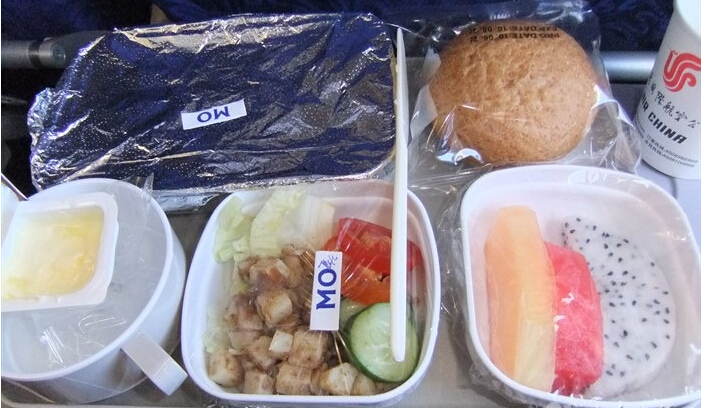
When an airline offers meal choices, do you hesitate at the 'Muslim meal' checkbox? Have you ever considered this inconsistency: a kosher meal is offered for followers of Judaism, but Muslims have no clear term 'Halal meal' option?
Airlines mainly offer three types of meals on planes: Muslim meal (MOML), kosher meal (KSML) and Hindu meal (HNML).
MOML refers to the Halal meal, KSML refers to a meal compliant with Jewish law, and HNML is a vegetarian meal suitable for Hindus.
The Halal meal problem
The Halal industry has been concerned about this issue for years, as Mohamed Jinna, CEO of the Halal India certification body, said in his 2011 open letter to the International Air Transport Association (IATA): 'Today, there are many in-flight meal suppliers who claim and label their meals as 'MOML,' but without a proper Halal certification process being tracked, they themselves declare that these foods are suitable for Muslim travelers to eat.'
'Muslim meal (MOML)' is wrongly discriminatory, implying it is only for Muslims, when it is Halal food—not only for Muslim consumers.
Furthermore, the code 'MOML' currently stipulated by IATA, which many people would consider to represent Halal-certified food, does not necessarily mean any type of certification.
But is it Halal-certified?
For example, Finnair describes the Muslim meal like this: 'The food is selected, prepared and served according to Islamic dietary laws and customs. It contains no pork or pork by-products, gelatin, alcohol, flavor extracts containing alcohol, or fish that is not white-fleshed from species without scales or fins.'
However, many Muslims eat salmon and shrimp, and Finnair's customer operator did not confirm to us whether they have Halal-certified meals. In fact, it only explained that their meal suppliers vary by geographic location.
British Airways states on its website: 'Contains no pork, pork by-products or beverages containing alcohol. All meat comes from animals slaughtered according to Islamic law. May not be served on some European flights.'
But the question is, is this slaughter process certified by a trustworthy official body? An email sent to British Airways for more information has not yet received an immediate reply.
Even Garuda Indonesia, which won the title of the world's best airline for Halal travelers at the 2016 World Halal Tourism Awards with 1.9 million votes from 116 countries, also has no detailed description of its meals on its website.
However, Garuda's global customer service center said in reply to our inquiry: '...we confirm that our meals are Halal-certified, and the Muslim meal on Garuda Indonesia international flights is edible.'
In another Muslim-majority country, Turkish Airlines also has no special category for the Muslim meal, but the airline's sidebar states: 'All meals served on Turkish Airlines flights are Halal food prepared according to Halal dietary requirements.'
Similarly, Emirates says: 'All Emirates meals are suitable for Muslims, prepared according to Halal requirements... containing no pork, alcohol or any non-Halal dishes.'
Interestingly, although Malaysia Airlines states on its website that it only offers Halal food on flights, and that its food is prepared 'according to Halal rituals and methods,' it has a clearer statement for kosher: 'Our kosher meals are confirmed to comply with Jewish law and are prepared and packaged by kosher-certified manufacturers.'
Considering all these different airlines, how can consumers know that a company's definition of Halal is sufficient to comply with official certification and industry-recognized Halal standards? Logically, a unified standard regulation should be used.