Halal comes from Arabic, meaning 'lawful' or 'permitted' (translated into Chinese as 'Qingzhen'). Halal assures all Muslim consumers that food is processed according to Halal regulations (Sharia). The food consumed by the Muslim community in daily life complies with the processes and procedures stipulated by Halal regulations, which also concern nutrition and ensure quality. Halal certification bodies also provide guidelines that food manufacturers or processors should follow to establish a Halal process. Although this certification applies to the meat industry, it also applies to industries processing milk, canned food and additives. Halal certification will help the Muslim community identify acceptable food and will also help the business community in minority areas flourish.
What are the benefits of Halal certification?
* Food that complies with Halal dietary guidelines, suitable for 1.9 billion consumers worldwide with Halal dietary needs.
* Maintaining an upright and ethical lifestyle by avoiding animal abuse, environmental harm and unfair business practices
* Providing quality systems and good practices to build a trustworthy reputation among customers
* A platform to enter international markets
* Promoting other supporting standards such as HACCP and Good Manufacturing Practice (GMP)
Who can obtain Halal certification?
* Food processing industry
* Meat slaughterhouses
* Restaurants and kitchens
* Dairy industry
* Others
What are the requirements for Halal certification?
* Muslim personnel certified according to Halal slaughter procedures
* Resource management - general, personnel, facilities and environmental conditions and equipment (utensils)
* Process requirements - preparation, processing, packaging, transportation and storage
What is the procedure for Halal certification?
Enquiry
Enquiry with halal certification specialist
Brief on international halal certification based on HALMQ
SUBMISSION
Submission of application form
Assessment of application
Brief on halal certification project & quote
IMPLEMENTATION
Development & implementation of HALMQ
Audit on documentation and physical premise
CERTIFICATION
Issuance of halal certificates upon successful audit (1 year validity)
POST-CERTIFICATION
Periodic surveillance audit
Processing of additional applications
RENEWAL
Issuance of reminder letter for renewal of halal certificates
Processing of renewal applications
Issuance of renewed halal certificates (1 year validity)
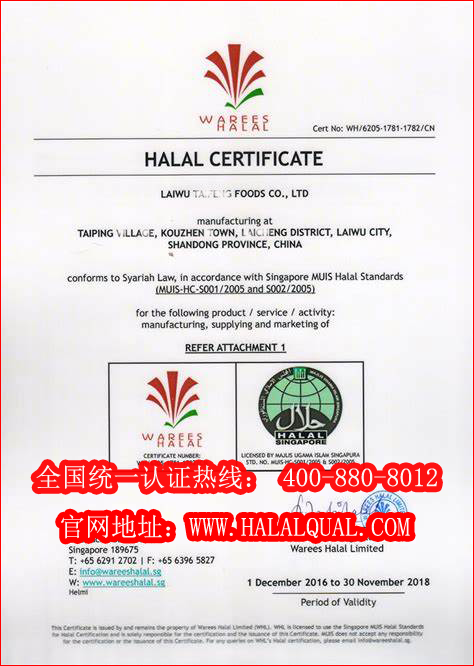
What does a Halal certificate look like?