
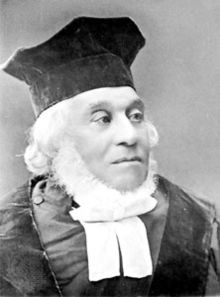
From 1845 until his death, Rabbi Nathan Marcus Adler (13 January 1803 - 21 January 1890) was the Orthodox Chief Rabbi of the British Empire. In English-speaking countries, Adler was perhaps the most prominent rabbi of the 19th century.
Rabbi Nathan was born in present-day Hanover, Germany. He apparently became famous because of the kabbalist Adler of Nathan's line (according to the latter's biography in the Jewish Encyclopedia). His distant relative Jacob Adler, who knew him in the winter of 1883-1884, described him as 'the supreme religious authority not only of London's Jews but of all Orthodox Jews throughout Britain and the Empire.' He was described as famous for his Frankfurt Orthodoxy.
Although the rabbi had become acquainted in Hanover with Prince Adolphus, Duke of Cambridge and Viceroy of the province, who thought of recommending him for the British post of Chief Rabbi.
Besides 13 candidates mostly from Germany, he joined the list for the position of Chief Rabbi of the British Empire. The other three were: Raphael Hirsch, Benjamin Hirsch Auerbach, and Hirsch Hirschfeld. With 135 communities voting, each casting only one vote, on 1 December 1844, Adler received 121 votes, with Hirschfeld receiving 12 and Hirsch 2.
The first university-educated British Chief Rabbi, and the first to undertake regular pastoral tours within Britain, he was also a founder of the National Society for the Prevention of Cruelty to, and Better Protection of, Children. During his tenure, the emancipation of the Jews within Britain was completed; the election (1847) and taking of his seat (1858) of Lionel de Rothschild as the first Jewish member of Parliament; Nathan Mayer Rothschild's elevation as the first Jewish member of the House of Lords (1885); and Sir David Salomons being appointed the first Jewish Lord Mayor of London (1855).
In 1870, Adler provided great help in establishing the United Synagogue through an Act of Parliament. Until 2006, this remained the largest Jewish community in Britain and continued to follow the religious authority of the Chief Rabbi.
Adler was also involved in scholarly activities, such as writing, editing and translating. For example, in 1907 his critical text, translation and commentary on Benjamin of Tudela's important medieval work 'The Itinerary of Benjamin' was launched. His work was Netinah LaGer, on the law of Targum Onkelos.
Adler was buried in the Willesden (United Synagogue) cemetery in Britain.