
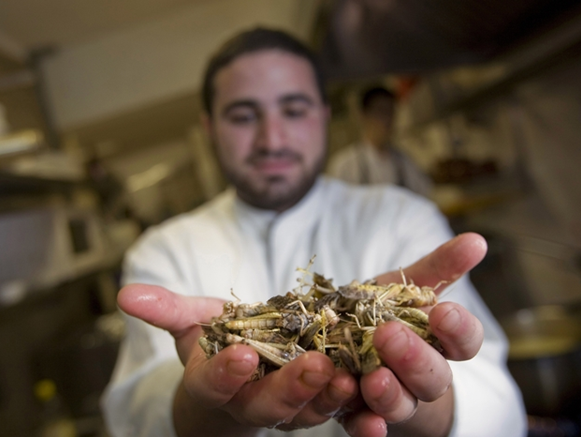
Since locusts were declared legal Kosher food in 2010, an Israeli chef has showcased dishes made from locusts at a Jerusalem restaurant.
This week, a large swarm of locusts that had ravaged Egypt's crops flew to neighboring Israel. With Passover approaching, many news outlets independently recalled the biblical story of Exodus, when the locust plague was one of the ten plagues God sent upon Pharaoh and his people.
Just as Israeli farmers worried that the insects would destroy their crops, other Israelis proposed solving the pest problem from a culinary angle: why not eat these creatures up?
This is indeed a clean solution, but there is a problem: rabbis cannot reach a consensus on whether locusts are Kosher.
One of the main proponents of promoting the legality of cooking locusts is the famous Israeli chef Moshe Basson, who appeared on a Wednesday morning news program to teach people how to make a locust concoction.
"They taste somewhere between sunflower seeds and small shrimp, with a bland flavor," Basson told The Guardian. "I like eating them, but people seem more willing to try them out of novelty than for the taste."
Basson is famous for dishes he created inspired by the Bible. A few years ago, his restaurant The Eucalyptus served fried locusts as dessert at a widely publicized banquet, aiming to revive the ancient local Kosher dietary tradition.
Others also proposed trying to make Passover side dishes with locusts: "As the only Kosher insect, the locust is the best choice for a housewife who has not yet decided what appetizer to use for the Passover seder," Allison Kaplan Sommer wrote in Haaretz.
Creative recipes such as "honey five-spice locust" quickly proliferated on blogs. Rabbi Natan Slifkin, who studies the intersection of Judaism and the animal world, expressed his view on eating insects from an ecological perspective in his column in The Times of Israel:
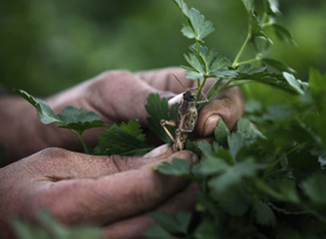
On Tuesday, a Palestinian farmer in Khan Younis in the southern Gaza area found a locust, and this week a large swarm of locusts came from neighboring Egypt to Israel and the Hamas-ruled Gaza area.
"Can you imagine the impact if Jews, instead of exploiting animals, industrializing farms and indulging in gastronomic enjoyment, obtained their food in a more environmentally friendly and animal-friendly way?"
However, not everyone joined the locust-eating army. Rabbi Yitzhak Yosef, son of one of Israel's most influential ultra-Orthodox religious leaders, warned that these delicious locusts may not be Kosher at all.
The Old Testament's attitude on whether locusts can be eaten is admittedly quite ambiguous. The Jerusalem Post noted that Leviticus warns that "all creeping things that creep upon the earth are an abomination; they shall not be eaten." It also noted that the Law, also part of the Old Testament, lists the following four locusts - "red, yellow, gray-spotted and white" - saying they are all edible.
Yemenite Jews have eaten locusts for hundreds of years, so the Jewish community there never questions the Kosher status of locusts.
So the real question seems to be whether European Jews, namely Ashkenazi Jews, consider locusts Kosher. They have no tradition of identifying whether a locust is of a biblically approved species. Ashkenazi rabbis are also divided on this.

Some Jews believe locusts should not appear on the Passover seder table.
"Communities with the custom of eating locusts allow them at the Passover seder," Yosef said on Wednesday. "But most Israelis would not do so. We cannot go only by the label, not even for locusts."
It may sound nitpicky, but the tug and clash of various interpretations is a feature of the Jewish scholarly tradition.
Still, for those who favor locusts being Kosher, gourmets around the world - from the Netherlands to Mexico to the San Francisco Bay Area - offer various ways to cook insects, which are rich in protein.
Or, more simply, Israelis can follow the Thai practice of frying locusts into a crunchy side dish. According to urban legend, locusts first appeared on Thai tables decades ago during a locust plague in Thailand.
The ancient Egyptians probably regretted not having considered this beforehand.
FAQ
- Are locusts Kosher for Passover?
- Since locusts were declared legal Kosher food in 2010, there has been debate. The Old Testament's attitude is ambiguous: Leviticus warns that creeping things are an abomination, yet the Law lists four edible locusts (red, yellow, gray-spotted and white). Yemenite Jews have eaten locusts for hundreds of years and never question their Kosher status, but European (Ashkenazi) Jews have no tradition of identifying biblically approved species and their rabbis are divided. As Rabbi Yitzhak Yosef said, communities with the custom of eating locusts allow them at the Passover seder, but most Israelis would not, since one cannot go only by the label.