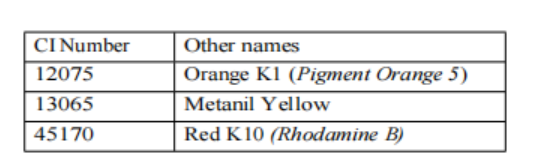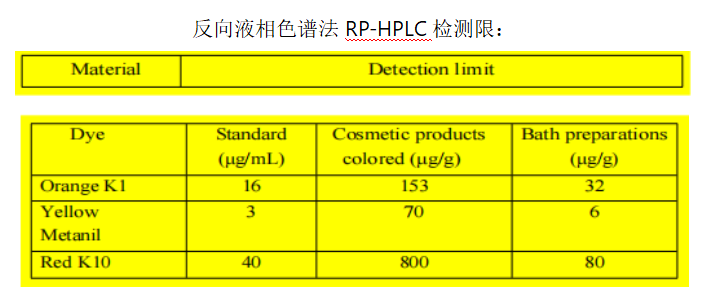
A. Determination of microbial contamination in cosmetics A.1 Determination of mold and yeast counts and total plate count in cosmetics. Principle: This method involves counting molds and yeasts on a selective agar medium. If it is estimated that the sample may inhibit microbial growth, the sample must be neutralized so that live microorganisms can be detected, and the neutralization procedure must be validated. A.2 Testing the efficacy of cosmetic preservatives. Principle: A challenge test is performed on an uncontaminated product using established standard microorganisms, after which the inoculated product is kept at a specified temperature. At specified time intervals, the plate-count method is used to count the number of standard microorganisms surviving in the test product. B. Analytical method for determining the level of heavy-metal (arsenic, cadmium, lead, mercury) contamination in cosmetics Principle: The sample is digested using wet digestion, dry digestion or high-pressure microwave digestion (HPMD), and the content of heavy metals such as arsenic (As), cadmium (Cd), lead (Pb) and mercury (Hg) is determined using a graphite-furnace atomic absorption spectrophotometer (GF-AAS) and a flow-injection analysis system–atomic absorption spectrophotometer (FIAS-AAS). C. Identification of retinoic acid in cosmetics Principle: Retinoic acid is identified using thin-layer chromatography (TLC) and high-performance liquid chromatography (HPLC). D. Identification of banned colorants in cosmetics Thin-layer chromatography (TLC) identification of banned colorants. Principle: Banned coloring components in cosmetics are extracted and identified by thin-layer chromatography (TLC). High-performance liquid chromatography (HPLC) identification of banned colorants. Principle: Banned colorants in cosmetics are identified by reversed-phase liquid chromatography combined with visible-light detection. E. Identification and determination of hydroquinone content in cosmetics Thin-layer chromatography (TLC). Principle: Hydroquinone is identified by thin-layer chromatography. HPLC method. Principle: Hydroquinone is identified by reversed-phase HPLC with UV detection. F. Identification of corticosteroid compounds in cosmetics Thin-layer chromatography (TLC). Principle: Corticosteroid compounds in the sample are extracted and identified by thin-layer chromatography (TLC). HPLC method. Principle: Glucocorticoid compounds in the sample are extracted and identified by reversed-phase HPLC combined with UV detection. G. Identification of several preservatives used in cosmetics Thin-layer chromatography (TLC). Principle: Preservatives in the sample are extracted and identified by TLC. HPLC method. Principle: Preservatives in the sample are extracted, identified, and their content determined by reversed-phase HPLC, using isopropyl 4-hydroxybenzoate or benzophenone as an internal standard.
FAQ
- What are the main cosmetics testing programs of Indonesia's BPOM?
- BPOM cosmetics testing programs mainly include: A) determination of microbial contamination (mold and yeast counts, total plate count, and preservative-efficacy challenge testing); B) determination of heavy-metal contamination levels (after wet/dry/high-pressure microwave digestion, the arsenic, cadmium, lead and mercury content is determined using GF-AAS and FIAS-AAS); C) identification of retinoic acid (TLC and HPLC); D) identification of banned colorants (TLC and HPLC); E) identification and determination of hydroquinone; F) identification of corticosteroid compounds; G) identification of several preservatives (TLC and HPLC).