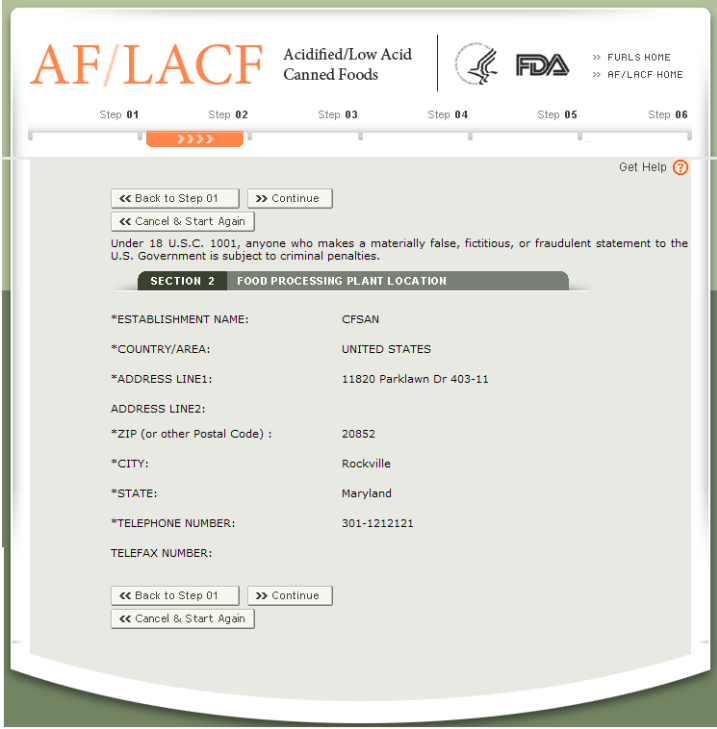
When Chinese food businesses export low-acid or acidified canned food to the United States, they must complete a three-tier registration: Food Facility Registration (FFR), Food Canning Establishment registration (FCE), and Scheduled Process registration (SID). Many Chinese canning businesses wrongly assume that completing the general Food Facility Registration (FFR) is enough to export, and only discover that they are missing the FCE and SID registrations when their goods are detained at U.S. customs, causing serious losses. Tier 1: Food Facility Registration (FFR) Who it applies to : all facilities that manufacture, process, pack or store food for consumption in the United States. Registration content : Basic facility information (name, address, contact) U.S. Agent information Food category (select 'canned food') Validity : renewed every two years (in even-numbered years, 1 Oct - 31 Dec) Registration platform : the FDA Food Facility Registration (FFR) system Tier 2: Food Canning Establishment registration (FCE) Who it applies to : all facilities producing low-acid or acidified canned food. Registration content : Detailed information on the canning facility List of processing equipment (retorts, can seamers, etc.) Description of the quality-control system Proof of qualification for the processing supervisor (Better Process Control School completion certificate) Special requirements : At least one 'processing supervisor' with an FDA-recognised training certificate must be appointed The facility must meet CGMP requirements How to register : electronic or paper registration, submitted or sent to the FDA Tier 3: Scheduled Process registration (SID) Who it applies to : every low-acid or acidified canned product formula. Registration content : Product formula and ingredient proportions Container type and size Thermal processing parameters (temperature, time, pressure) Process flow chart Scientific validation report of the scheduled process (issued by a processing authority) Key concept : a 'scheduled process' is a set of thermal-processing parameters that have been scientifically calculated and experimentally validated to ensure that the product reaches commercial sterility under specific conditions, i.e. the elimination of all pathogenic bacteria and spores. How to register : electronic or paper registration, mailed or faxed to the FDA FDA Application Process and Document Preparation for Chinese Canning Companies Application order (must be completed in sequence) Complete the FFR food facility registration (online application, takes effect immediately) Submit the FCE canning establishment registration Submit the SID scheduled process registration Processing Supervisor Training Requirements Under 21 CFR 113.10, a canning facility must appoint at least one person who has completed 'Better Process Control School' training to supervise thermal processing operations. Training content includes : Microbiology of low-acid foods Principles and calculations of thermal processing Equipment operation and maintenance HACCP and CGMP requirements Practical advice Chinese businesses can send staff to recognised training courses in the United States or in the Asian region, or engage a qualified consultant to act as the processing supervisor.
FAQ
- Why does exporting low-acid canned food to the US require three tiers of FDA registration?
- When Chinese food businesses export low-acid or acidified canned food to the United States, they must complete three tiers of registration: Food Facility Registration (FFR), Food Canning Establishment registration (FCE) and Scheduled Process registration (SID). The reasons are: (1) public health and safety - low-acid foods (pH above 4.6) and acidified foods can breed Clostridium botulinum and cause fatal poisoning if processed improperly in sealed containers; (2) thermal-process validation - the FDA requires each product formula and process to be scientifically validated to ensure adequate sterilisation; and (3) facility supervision - canning facilities must meet CGMP and accept periodic FDA inspections. Many Chinese canners wrongly assume that the general FFR is enough to export, and only discover the missing FCE and SID registrations when goods are detained at U.S. customs.
- What are low-acid canned foods (LACF) and acidified foods, and why are they higher-risk?
- Under 21 CFR 113.3, low-acid canned food (LACF) means any food in a sealed container with a pH above 4.6 and a water activity above 0.85, such as canned vegetables, meat, seafood and soups; acidified food means low-acid food whose final pH has been reduced to 4.6 or below by adding an acid (such as vinegar or citric acid), such as pickles and salsa. The core reason for the high risk is Clostridium botulinum poisoning: its spores can multiply and produce a deadly toxin in low-oxygen, low-acid (pH above 4.6), room-temperature environments, and the sealed environment of canned food creates ideal anaerobic conditions for growth. Low-acid foods must be sterilised at a sufficiently high temperature, and acidified foods must be acidified evenly and thoroughly, otherwise pathogens may survive.