
FDA Food Facility Registration
What Is the FDA?
The FDA (U.S. Food and Drug Administration) is the federal public-health agency of the United States responsible for regulating relevant matters. It is part of the Department of Health and Human Services.
Products Regulated by the FDA
1. Human drugs
- Prescription drugs
- Over-the-counter (OTC) drugs
- Generic drugs
2. Biologics
- Vaccines
- Blood supply
- Blood products
3. Medical devices
- From simple devices such as tongue depressors
- To complex technologies such as cardiac pacemakers
4. Radiation-emitting products
- Microwave ovens
- Tanning beds
- Laser pointers
5. Food
- Food safety
- Food additives (including irradiation used in food processing)
- Infant formula
- Dietary supplements
- Food utensils
- Containers and packaging materials
6. Cosmetics
7. Veterinary products
- Livestock and pet food
- Animal drugs
8. Tobacco products
9. Colour additives
- For use in food, drugs and cosmetics
Key Aspects of the U.S. Food Safety System
The FDA is responsible for the safety of about 80% of the food consumed in the United States, including both domestically produced and imported food.
Exception: regulated by the USDA
The following products are regulated by the U.S. Department of Agriculture (USDA):
- Meat and meat products
- Poultry and poultry products
- Catfish
- Frozen and processed eggs (liquid, dehydrated, etc.)
- Matters relating to animal and plant health
Exception: regulated by the TTB
The TTB (Alcohol and Tobacco Tax and Trade Bureau) regulates:
- Alcoholic beverages with an alcohol content of more than 7%
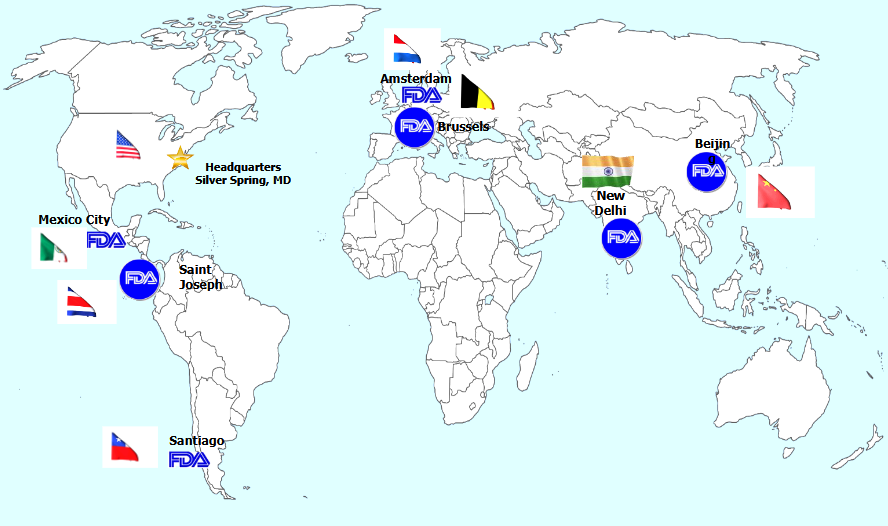
FDA International Offices
General Information on Exporting Food to the United States
All food intended for import into the United States must meet the same requirements as domestic U.S. products, including:
- Food safety requirements
- Good Manufacturing Practice (GMP), Good Agricultural Practice (GAP) or other applicable practices
- Facility registration
- Labelling requirements
- Special requirements for specific products
For example: acidified foods, shelf-stable low-acid foods, milk, fish and shellfish, juices and purees, etc. - Compliance with the Food Safety Modernization Act (FSMA)
In addition, you must comply with the Prior Notice system.
You must also be able to cooperate with and accept FDA inspections.
Food Facility Registration
Why Do Food Facilities Need to Register?
Food facility registration is a necessary procedure for complying with U.S. law. The relevant regulations can be found in the U.S. Code of Federal Regulations:
Title 21, Chapter I, Subchapter A, Part 1, Subpart H
https://www.ecfr.gov/current/title-21/chapter-I/subchapter-A/part-1/subpart-H?toc=1
The information submitted at registration helps the FDA understand food businesses operating within the United States, and also helps to identify the likely source and location of food in the event of a foodborne illness outbreak or a potential bioterrorism incident.
Who Must Register?
The following types of facility must register:
- Manufacturers or processors
- Packers
- Storage facilities
Scope of Application
The requirement applies to all facilities, rather than to the company or joint venture itself.
For example:
- A company with 10 facilities in different locations
- Export logistics companies
- Companies with a separate headquarters
About Facility Registration
- You must select a U.S. Agent.
- The system verifies whether the chosen U.S. Agent agrees to act as the company's agent.
- Once verification is complete, the system sends an email to the registrant containing a Registration Number and Personal Identification Number (PIN).
- If any of the facility's registration details change, the registration information must be updated within 60 days.
- If a registered facility undergoes any of the following changes:
- Change of address
- Change of ownership
- Company merger
Unique Facility Identifier (UFI)
- Under 21 CFR 1.232(a)(2), since 1 October 2020, both domestic and foreign facilities must provide a Unique Facility Identifier (UFI) accepted by the FDA.
- The UFI currently recognised by the FDA is the DUNS number (Data Universal Numbering System number).
- The DUNS number is assigned and managed by Dun & Bradstreet.
- To apply for a DUNS number, see: https://www.fda.gov/media/143997/download
Advice on the Unique Facility Identifier (UFI)
- Use your own actual address; do not use the information of an agent or freight forwarder.
- Do not use the headquarters location; each facility must have its own DUNS number.
- The legal name and address of the facility in the FDA registration application must match the DUNS information.
- The DUNS number is free and can be changed up to four times within 90 days.
DUNS Contact Information
- Phone: 1-866-705-5711
- Email: ImportSafetySupport@DNB.com
- Website: https://importregistration.dnb.com/
DUNS Contact in China
- Phone: 400-820-3536
- Email: inquiryCN@dnb.com
- Website: https://www.dnb.com.cn/
Registration Cancellation
- Until the FDA has verified the accuracy of your facility's UFI and confirmed that the specific address of the facility corresponding to that UFI matches the address in the registration information, the FDA will not confirm your registration or issue a registration number.
- The FDA verifies the submitted UFI. (Under 21 CFR 1.231(a)(3) and (b)(5), and the relevant D&B requirements.)
- Since 10 March 2023, any FDA Food Facility Registration (FFR) that does not provide an accurate Unique Facility Identifier (UFI) will be cancelled.
- Affected businesses can reinstate their registration once they have provided the required UFI information.
FAQ
- What is FDA food facility registration, and which facilities must register?
- Food facility registration is a necessary procedure for complying with U.S. law, set out in the U.S. Code of Federal Regulations, Title 21, Part 1, Subpart H. The information submitted helps the FDA understand food businesses in the United States and identify the likely source and location of food in the event of a foodborne illness outbreak or potential bioterrorism incident. Facilities that must register include manufacturers or processors, packers, and storage facilities. All food intended for import into the United States must meet the same requirements as domestic products, including food safety requirements, Good Manufacturing/Agricultural Practice (GMP/GAP), facility registration, labelling requirements, special requirements for specific products (such as acidified foods, low-acid foods, milk, fish and shellfish, and juices), and compliance with the Food Safety Modernization Act (FSMA); businesses must also comply with the Prior Notice system and cooperate with FDA inspections.
- What does the FDA regulate, and which foods are regulated by the USDA or TTB instead?
- The FDA (U.S. Food and Drug Administration) regulates a wide range of products, including human drugs (prescription, OTC and generic), biologics (vaccines, blood products), medical devices, radiation-emitting products, food (food safety, additives, infant formula, dietary supplements, utensils and packaging), cosmetics, veterinary products, tobacco products and colour additives. The FDA is responsible for the safety of about 80% of the food consumed in the United States. Exceptions: meat and meat products, poultry and poultry products, catfish, frozen and processed eggs, and matters relating to animal and plant health are regulated by the U.S. Department of Agriculture (USDA); alcoholic beverages with an alcohol content above 7% are regulated by the Alcohol and Tobacco Tax and Trade Bureau (TTB).