
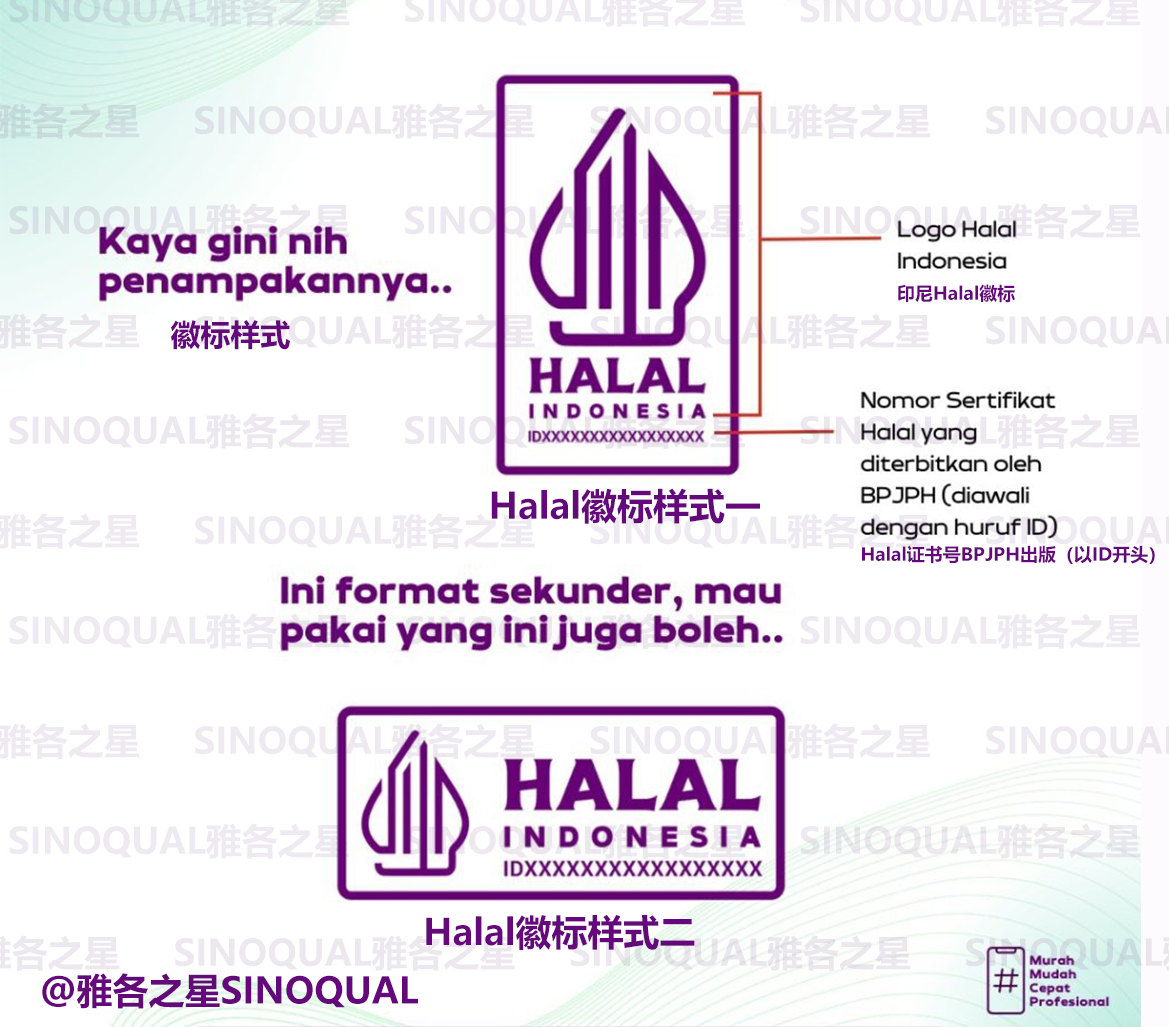
The Indonesian government established the Halal Product Assurance Agency (BPJPH), responsible for formulating Indonesia's own halal certification regulations and policies. Based on BPJPH's 2022 decision on establishing the halal label, the government issued the new version of the Indonesian Halal mark. This ruling is the implementation of Article 37 and Article 33 of the 2014 Halal Product Assurance Law.
Please note that the new Indonesian Halal mark is protected by intellectual property rights in the database of the Directorate General of Intellectual Property and may not be commercialized without permission.
According to the provisions of Article 1, paragraph (5) of the Trademark Law, trademark rights are exclusive rights granted by the state to the owner of a registered trademark for a certain period of time, through use by the owner itself or by licensing others to use it.
In addition, brands are classified as trademarks or service marks. A trademark is a mark used to distinguish goods exchanged by one person, a group of people or a legal entity from other similar goods.
Meanwhile, a service mark is a mark intended to distinguish services traded by one person or many people collectively or by a legal company from other identical services.
According to the provisions of Article 83, paragraph 1 of the Trademark Law, the trademark owner, as the owner of rights and obligations, has the right to make the following demands of the user:
'The owner of a registered trademark and/or the trademark licensee may bring a lawsuit against another party who illegally uses a trademark similar or identical to that for similar goods and/or services, in the form of:
A claim for damages; and/or
Cessation of all acts related to the use of the mark.'
In addition to civil litigation, the parties may also resolve issues through arbitration or other dispute resolution methods.
Moreover, those who violate the Trademark Law may face criminal charges. The criminal provisions of Article 100, paragraphs (1) and (2) of the Trademark Law are as follows:
'(1) Anyone who illegally uses a trademark identical to another party's registered trademark for similar goods and/or services that are produced and/or traded shall be sentenced to imprisonment of up to 5 (five) years and/or a maximum fine of Rp 2,000,000,000.00 (2 billion Indonesian rupiah).
(2) Anyone who illegally uses any trademark substantially similar to another party's registered trademark for similar goods and/or services that are produced and/or traded shall be sentenced to imprisonment of up to 4 (four) years and/or a maximum fine of Rp 2,000,000,000.00 (2 billion Indonesian rupiah).'
Therefore, it can be said that the Indonesian Halal label, including a logo, name and text in the form of 2 (two)-dimensional and/or 3 (three)-dimensional color arrangement, is an element that contributes to brand cohesion.
As for BPJPH, as the body that provides services in the form of implementing halal product assurance in accordance with legislative provisions, the Indonesian Halal mark is one of the objects protected by the Trademark Law.
In addition, according to the Intellectual Property Database ('PDKI') website, since 19 January 2022, the Indonesian Halal label has been protected under Class 42 in the form of a product certification service. After a trademark is registered with the Directorate General of Intellectual Property ('DJKI'), the trademark owner holds rights to the trademark.
Therefore, trademark registration is crucial for business entities, the government and other parties that use trademarks as identifiers or distinctions of goods and/or services held by individuals or legal organizations.
The protection of a trademark grants the trademark owner exclusive rights provided by law and protected by the government. Therefore, the brand owner obtains legal certainty. After all, anyone who misuses and/or commercializes the Indonesian Halal label will face legal consequences.