
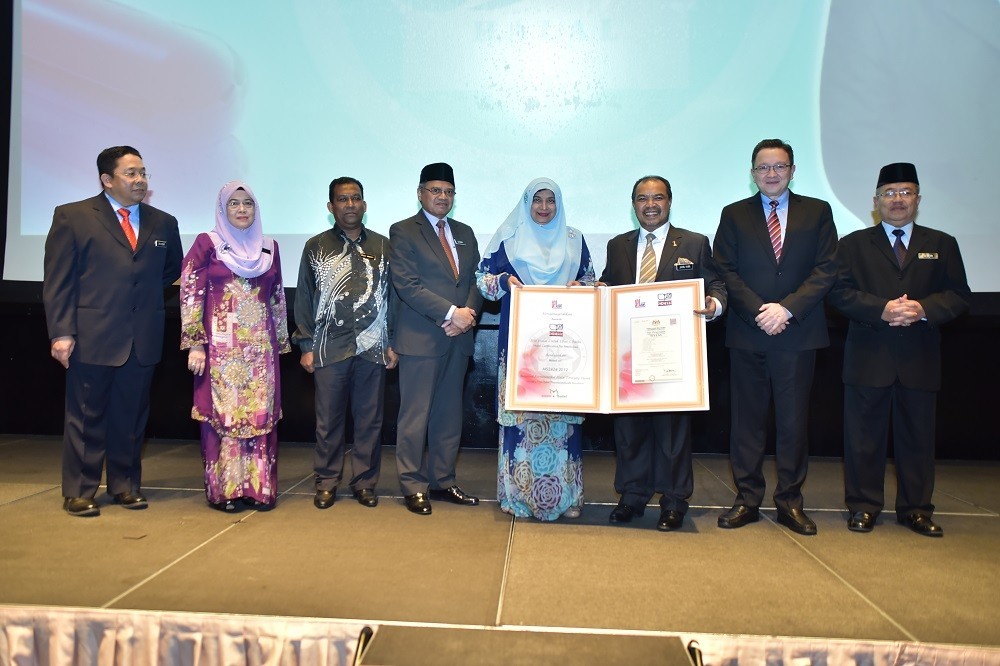
JAKIM has created another milestone in the global Halal industry, becoming the world's first certification body to certify controlled/prescription drugs. The Halal certificate for over-the-counter drugs was awarded to Chemical Company of Malaysia (CCM) at a special award ceremony at the Pullman Putrajaya.
The Halal pharmaceutical standard MS2424:2012 was jointly developed by Malaysia's Ministry of Science, Technology and Innovation (MOSTI), JAKIM's Halal Hub Division, the National Pharmaceutical Regulatory Agency (NPRA), industry representatives, and experts in Islamic jurisprudence and science. Before this Halal pharmaceutical standard was available, the Halal food standard MS1900 served as a fallback guide for drug manufacturers. This was not ideal, because the Halal food standard is not applicable to the complex, highly government-regulated and high-tech pharmaceutical industry. Before releasing MS2424, through many exchanges, seminars, and one-on-one communication with industry leaders and experts, JAKIM's Halal Hub Division successfully developed a certification system based on this standard, which can be used not only by pharmaceutical companies in Malaysia and around the world but is also recognized by Halal certification bodies acknowledged worldwide.
The certificate was awarded to CCM by Dato Seri Jamil Khir bin Hj Baharom, Minister in the Prime Minister's Department. This certification marks a new era for Halal pharmaceuticals entering local and international markets, because a wider range of Halal pharmaceutical products manufactured by CCM has now been officially certified by JAKIM and will be available to consumers, giving them more informed choices in medicinal products.
The event also witnessed another important achievement by JAKIM, when its Halal Hub Division recognized nine organizations from Japan, Kazakhstan, the Maldives and Spain as foreign certification bodies. This clearly reflects JAKIM's prominent position in the field of global Halal certification.
Due to Malaysia's high standards and strict adherence to Halal principles, Malaysia's certification and mark are accepted and recognized worldwide. The global Halal pharmaceutical prospect is currently worth US$7.5 billion and is estimated to reach US$13.2 billion by 2021. Malaysia is ready to increase its presence and leadership in this industry, which is a new milestone achieved by JAKIM.
Praising the efforts of JAKIM and CCM in creating historic progress for Halal pharmaceuticals, Dato Seri Jamil Khir, Minister in the Prime Minister's Department, said: 'This landmark certification of CCM will bring a greater boost to the pharmaceutical industry both domestically and globally. We hope this will lead to broad participation by pharmaceutical manufacturers worldwide, as well as mutually recognized Halal certification bodies, to ensure that prescription drugs, vitamins and health products comply with Halal certification regulations, thereby providing better options for both Muslims and non-Muslims. Halal-certified products are not only permitted for Muslims to use but also have the advantages of being safe, effective, high-quality and hygienic.'
The 'Halal' standard should be key to healthcare and pharmaceuticals. In other words, there should be a convergence of Islamic jurisprudence and science—Malaysia can and should be driving its development, considering that the country implemented the world's first Halal pharmaceutical standard, MS2424, in 2012.
The minister added: 'We hope global companies will view the country as a new regional hub to serve the expanding global Halal market. Muslims need to gain more knowledge in the medical field and make informed decisions, because if there is a choice, Muslims must avoid choosing non-Halal and doubtful ingredients. Do not return to ignorance as an excuse for not practicing the Islamic creed.'
Currently, Halal pharmaceuticals are estimated to account for one-third of the total revenue of the global Halal market, which offers a highly attractive opportunity for drugs that comply with Halal regulations. The fact is: demand for Halal pharmaceuticals exceeds supply, which greatly increases the industry's future potential for economic value-add.
For a long time, Halal pharmaceuticals were outside the factors of certification regulatory compliance. MS 2424:2012 serves as a reference model for the pharmaceutical industry. In the production and consumption of Halal pharmaceuticals and, most importantly, in this highly specialized area of thought leadership, Malaysia is one of the most promising markets in the global Halal pharmaceutical field. The standardization of the Halal pharmaceutical market will increase the confidence of consumers worldwide.
On JAKIM's recognition of CCM's efforts and commitment to Halal, CCM's Chairman Dato Hajah Normala Binti Abdul Samad said: 'It is for this reason that we celebrate this recognition, which is important for CCM in advancing the level of Halal pharmaceuticals in Malaysia as well as globally. The pharmaceutical industry is an important part of Malaysia's healthcare sector, with high growth potential in both domestic and export markets. This industry has always been regarded by the government as a strategic industry that needs to be developed.'
Dato Hajah Normala also added that CCM hopes Halal pharmaceutical companies can also pave the way for creating local opportunities in the pharmaceutical ecosystem. CCM supports the government's call to strengthen local competitiveness in this niche industry, especially 'thought leadership,' inspiring the leadership of Malaysian Muslim scholars, scientists and subject-matter experts, promoting the convergence of mind and science to strengthen the influence of Halal pharmaceuticals locally and internationally, and contributing to the knowledge economy.
In Halal, non-Halal drugs are only permitted to be consumed when there is no other alternative, because the main purpose of Halal regulations is to protect life and health. However, Muslim populations worldwide are becoming increasingly informed and discerning in their choices, and are seeking and demanding pharmaceutical products that contain only Halal ingredients.
In awarding the certificate to CCM, JAKIM urged more pharmaceutical companies to follow CCM's example and make Halal part of their daily operations at every level, from management to operations. JAKIM also praised CCM's Halal Assurance Management System, which demonstrates CCM's commitment and assurance to educate the public that Halal-certified products benefit not only Muslims by confirming permissibility, but also everyone, because they also prove that products are safe, effective, high-quality and hygienic.
JAKIM also reiterated that Halal should be 'built-in, not tested-in,' and that all Malaysian Halal certificate holders should commit to always upholding the highest Halal standards, not just for the purpose of assessment or certificate renewal. Although JAKIM's Halal Hub Division conducts surveillance audits throughout the validity period of the Halal certificate, the usual assurance comes from within, just like CCM.