
Halal cosmetics are becoming increasingly popular among Muslim women in Bangladesh.
In Muslim-majority Bangladesh, people are becoming more brand-conscious and following trends, especially in fashion and cosmetics.
According to a report on the State of the Global Islamic Economy, last year Bangladeshis spent US$2.5 billion on cosmetics alone, making it the sixth-largest cosmetics buyer in the Muslim world.
One of the trends sweeping the Muslim world is 'modest fashion'—a specific style of dressing that incorporates the latest tastes, styles and trends, but within the bounds permitted by Halal regulations.
And the most fashionable label regarding cosmetics is—'Halal' cosmetics. Here Halal refers to the raw materials used in product production being within the bounds permitted by Halal regulations.
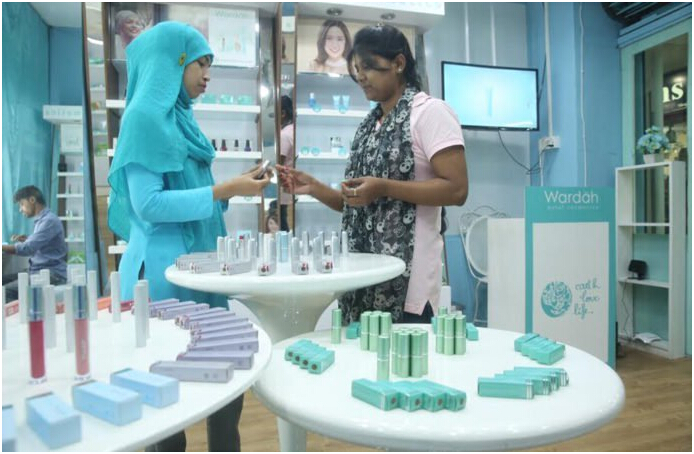
Bithi Haq, a university student, said she wants to follow the latest fashion trends without ignoring Islamic law. 'I want to wear popular and decent clothes like my friends,' she said. 'I have worn a hijab since I was 18, and I think it looks good.' She said she uses Halal cosmetics, but unfortunately, Bangladesh's market is not yet ready to produce Halal products for local consumers.
Another modest fashion enthusiast, Tasnima Tarannum Karishma, a doctor at Chittagong Agrabad Maa-O-Shishu Hospital, told the Dhaka Tribune, 'Under the global modest fashion trend, I use Halal cosmetics.' 'I have been using imported Halal cosmetics for three years. But with the arrival of the Indonesian cosmetics company 'Wardah,' I can now buy cosmetics here.' She added that she believes all Halal products are free of animal fat and alcohol.
Laila Zaman, a teacher at East West University, said she strictly adheres to 'Halal' and 'non-Halal.' 'Most perfumes contain alcohol, but I had to use them,' she said. 'But times have changed, and now I can use Halal perfume.'
Laila is also a regular customer of 'Wardah.' She said she uses Wardah's products because they are labeled 'Halal.'
Mustakima Rubi, president of the Bangladesh Beauty Association, told the Dhaka Tribune that about five years ago, people began using herbal products. 'This trend has changed, and in the past two years, consumers have been buying Halal products,' she said. 'Domestic demand for Halal cosmetics is increasing. Halal products are not just for Muslims; others can use them too.' Rubi said that although Unilever produces some Halal products, Bangladesh needs a company that produces only Halal cosmetics.
Wardah offers more than 300 Halal products
In Bangladesh, 'Symon AnMi' is Wardah's official business partner, an authentic Halal cosmetics company.
Wardah executives said Symon AnMi is a promising multinational enterprise. It is the first company in Bangladesh to introduce Halal cosmetics.
Symon Imran Hyder, chairman of Symon AnMi, said they started their business six months ago, and their motto is to build a qualified Halal cosmetics product line made up of the best brands. 'We want people to be able to buy quality products at any time,' he said. 'Bangladesh has some modest fashion enthusiasts who have begun to demand Halal cosmetics. We intend to meet their requirements.'
The company now offers more than 300 products. Malaysia, Indonesia and Bangladesh are Wardah's only official government partners.
Founded in 1985, Wardah is one of the most popular cosmetics brands in Indonesia. The company is GMP-certified and has the HAS Halal Assurance System.
Consumers can now find Halal products at two stores: Gulshan Police Plaza Shopping Mall and Dhanmondi Plaza AR.
FAQ
- What is the development status of the Halal cosmetics market in Bangladesh?
- Halal cosmetics are increasingly popular among Muslim women in Bangladesh. According to a report on the State of the Global Islamic Economy, last year Bangladeshis spent US$2.5 billion on cosmetics alone, making it the sixth-largest cosmetics buyer in the Muslim world. Driven by the 'modest fashion' trend, demand for Halal cosmetics (whose raw materials are within the bounds permitted by Halal regulations, free of animal fat and alcohol) is rising; the president of the Bangladesh Beauty Association notes that consumers have been buying Halal products over the past two years, and Halal products are not just for Muslims.
- What role does the Wardah brand play in the Bangladeshi market?
- Wardah is one of the most popular cosmetics brands in Indonesia, founded in 1985, GMP-certified and with the HAS Halal Assurance System, offering more than 300 Halal products. In Bangladesh, 'Symon AnMi' is Wardah's official business partner and the first company in Bangladesh to introduce Halal cosmetics. Malaysia, Indonesia and Bangladesh are Wardah's only official government partners.