
As Indonesia continues to rely on imported medical devices to support its medical sector, Halal product assurance is needed for medical devices that use animal products. The Indonesian government recently issued Halal Regulation No. 39, titled 'Implementing Halal Product Assurance,' to ensure the compliance of medical device manufacturers.
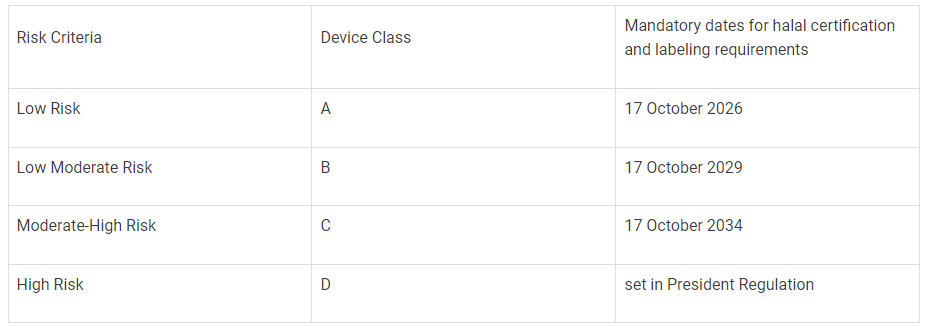
Currently, Halal certification of medical devices is voluntary. However, according to the provisions of the newly implemented Halal Regulation No. 39, medical devices containing animal-derived materials (ADM) will be subject to mandatory Halal certification registration according to the following timeline. Under Indonesia's Law No. 6 of 2023, Halal certification is valid long-term as long as the product's ingredients and Halal Product Process (PPH) do not change; the four-year validity set by GR 39/2021 no longer applies.
To date, many imported medical devices incorporate a range of materials into the finished product, including animal tissue and other materials of animal origin. These ADMs are common, mainly used in polymers to stabilize formulations or manufacture medical device components such as coatings, tubes, connectors and packaging.
ADMs can also constitute an important part of a finished device, such as bovine heart valves, bone substitutes and collagen injections. More importantly, fibers and resins commonly used in the medical industry—PVC, PP, Acetal, TPU, TPV, PE—may also contain ADM. Forestomach, gelatin, collagen, tallow, wool, fat, bone, heart valves, pericardium, chondroitin sulfate, submucosa, pericardial chitosan and hyaluronic acid are currently animal-derived technologies used in various clinical applications.
Although animal materials have advantages in treatment and biocompatibility compared with non-animal materials, the use of animal materials in medical devices is increasingly raising concern among the Muslim population.
The impact of Halal regulations on medical devices containing ADM
Since October 2019, the obligation to Halal-certify medical devices containing ADM has been in place. During various transition periods, medical devices that have not yet obtained Halal certification can circulate in Indonesia without specific labeling. However, once the respective transition period has passed, all products in that risk category must comply with Halal certification requirements, including labeling indicating whether the medical device containing ADM has passed Halal certification or not.
Special considerations
If a medical device has not passed Halal certification but is the only standard of care for treatment, the medical device is allowed to circulate on the market, but must be accompanied by special labeling. According to Halal Regulation No. 39, companies must use different colors to display the composition of ingredients. In addition, according to Indonesia's Halal Law (GR 33/2014) and Indonesia's 2019 Halal certification regulations (GR 31/2019), companies must mark their haram ingredients in red.
Indonesia Halal certification procedure
Under the new regulations, Halal certification in Indonesia is as follows:
Phase 1: HAS system establishment
The organization establishes a HAS system according to the HAS standard.
Phase 2: Submit the Halal certification application to BPJPH
1. After completing the HAS system, the organization submits the application to BPJPH and fills in the application materials.
2. Halal auditors audit the enterprise.
Phase 3: BPJPH determines the product status (Halal or non-Halal)
Halal product certification: BPJPH issues the Halal certificate within no more than 1 day
Non-Halal product designation: BPJPH issues a non-Halal statement letter within one (1) day.
What manufacturers or distributors must know when applying for a Halal certificate in Indonesia
Each raw material used in a medical device does not need a separate Halal certificate application, but the medical device must comply with the new Halal regulation requirements.
If you need Indonesia BPJPH-HALAL certification services, please contact us.